
Fairy
Casino NewsGame Guides

Philippines Casino Games Guides

Philippines Casino Games Guides offers practical tips and guides for popular casino games in the Philippines, including Super Ace.

Lucky Seven Review: The Scratch Card That Refuses to Behave Like a Slot
Lucky Seven
Lucky Seven Review: The Scratch Card That Refuses to Behave Like a Slot

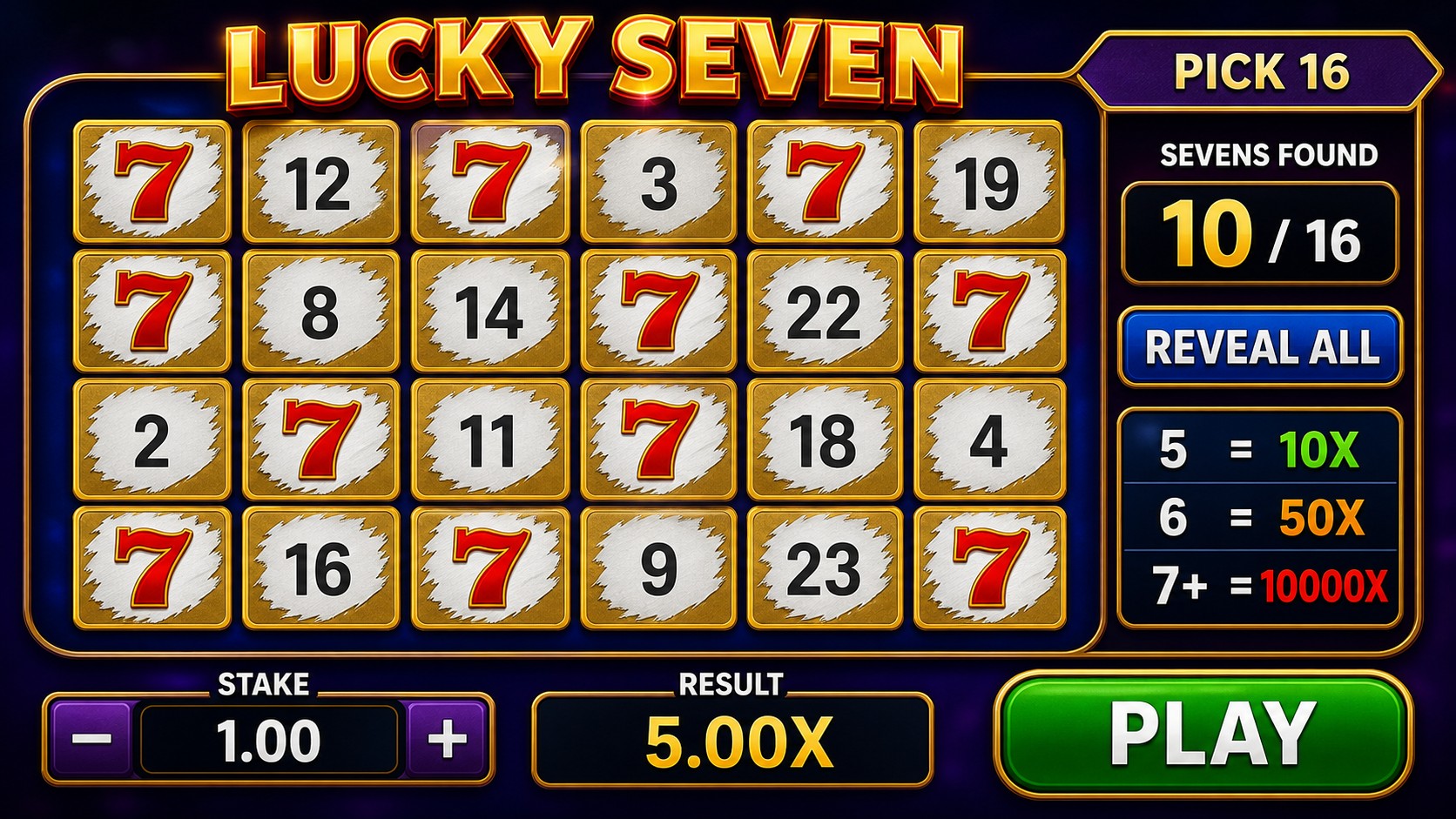
Lucky Seven should be judged by Pick 16 counter and Sevens Found total, not by its title alone. Secondary catalogues disagree between 96 and 97 percent return, while the published prize ladder is commonly described as 10 times for five sevens, 50 times for six and up to 10,000 times at the top condition. This review follows debit, state change and settlement instead of treating animation as proof of value. Public listings identify Lucky Seven as a Smartsoft instant or scratch-card game released in 2019 rather than a reel slot. The rule commonly shown is to reveal sixteen positions from a board of twenty-four and count red sevens. Exact regional terms remain a client-level fact. The three landscape pictures are original editorial reconstructions of the reported twenty-four-panel format. They are not Smartsoft screenshots, scratched tickets or evidence that any displayed number of sevens occurred. This article uses a strict evidence order: deployed help screen, studio rule sheet, regulated operator description and independent catalogue. Artwork proves identity and theme only; it cannot prove reel strips, hidden probability, trigger frequency or an operator return setting. No paid wager was placed and no age-confirmation screen was bypassed. Public pages supplied rules but did not expose a complete lawful demo session for direct capture, so there is no claimed personal hit rate, balance result or bonus sample. A reproducible test should record selected stake, starting balance, round identifier, every line or count component, feature entry, counter movement and final credit. That log cannot predict later rounds, but it can expose a misunderstood denominator or reset. Closely related games must be kept separate. Similar fruit, Japanese, apocalypse or Greek artwork does not guarantee the same return, purchase price, retrigger rule or maximum. The exact title and active help file define the product reviewed here. The three landscape images are explanatory mobile compositions. Values, positions and balances are props and must not be reused as proof of a trigger or win. For a useful first-session audit, twenty or thirty rounds are too small a sample for probability claims, yet they are enough to inspect interface behavior. Check the control after a network pause, the point at which the stake is debited, how results are itemized, where the rules open and if feature counters survive a reconnect. These observations cannot forecast outcomes, but they can prevent a display or unit mistake from being mistaken for game mathematics. A second pass should separate entertainment pace from financial pace. Time ten ordinary rounds at the lowest practical stake, then repeat at the intended stake without changing speed settings. Record total money placed, returned credit, longest blank stretch and the number of interruptions caused by animations or collection screens. The purpose is to see how quickly the interface can cycle money. Cash figures need context before publication. A multiplier normally refers to the base amount or total round stake defined by the help file, while a jackpot, feature prize or regional currency figure may use another denominator. Save the local rules and paytable beside the session log because those screens are the defensible reference when listings disagree.
Before the First Panel Opens

Lucky Seven opens with scratch-card audit. The red number sevens revealed beneath metallic panels and twenty-four covered cards, non-winning numbers, red sevens and a reveal counter are not background ornaments; they form a visual hierarchy that tells the eye where to look before any rule has been read. The reel area sits inside that hierarchy, so symbols remain distinct from the scenery instead of dissolving into it.

That first reading matters on a phone. A slot may spend heavily on illustration and still fail if the stake, spin control or settled result is hard to locate. Here the strongest idea is not mere decoration. It is the way deep violet, midnight blue, bright gold and signal red separates the game board, framing art and controls into layers.

Why Smartsoft Calls This an Instant Game

Public listings identify Lucky Seven as a Smartsoft instant or scratch-card game released in 2019 rather than a reel slot. The rule commonly shown is to reveal sixteen positions from a board of twenty-four and count red sevens. Secondary catalogues disagree between 96 and 97 percent return, while the published prize ladder is commonly described as 10 times for five sevens, 50 times for six and up to 10,000 times at the top condition.

These facts define the review frame. Operator help text still ranks first for local stake units, feature availability, return variant and cash cap.

The 96 Versus 97 Percent Problem

Public catalogues disagree between 96 and 97 percent. The running information panel must settle which return applies to the ticket being sold.

Because the entire ticket resolves in one round, the percentage still belongs to long-run turnover across many independent tickets. It does not describe the share returned by the next scratch.

Seven Is a Count, Not a Payline Symbol

The word Seven is the headline hook. It raises an obvious question: does it describe a multiplier, a progression, a visual motif or simply the scale of the story? Only the help screen can answer that. A number or power word in a logo is not automatically the highest cash ratio for a paid round.

Before treating the title as a promise, locate the line that defines it. Check the triggering symbols, the stage at which the value applies, any stake multiplier, the cap on simultaneous wins and any separate cash ceiling. If those conditions are absent, the name should remain a marketing label rather than a calculation.

Twenty-Four Panels and Sixteen Choices

This game has no reel geometry or payline route. The useful layout check is a six-by-four field of twenty-four panels, a sixteen-selection limit, a visible reveal counter and a final prize calculation.

Board dimensions alone do not settle a result. Direction, match length, units, substitution exclusions and simultaneous awards must be read together, except in Lucky Seven where the ticket uses symbol count instead of routes.

Red Sevens and Ordinary Numbers

The theme naturally divides the reel set into character or object symbols, special icons and ordinary revealed numbers. twenty-four covered cards, non-winning numbers, red sevens and a reveal counter carry more visual weight than the letters and numbers. That weight usually signals premium status, but the paytable may rank two similar objects very differently. Size and shine are clues, never final values.

Read every payout in the unit used by the game. Some tables show bet-per-line units; others use total stake. A five-of-a-kind figure can appear ten or twenty times larger if the unit is misunderstood. The cash meter after a test spin is useful, but the written help panel should settle the conversion.

Why Non-Winning Numbers Still Matter

ordinary revealed numbers occupy a large share of ordinary reel time in the editorial layout. They create visual breathing room around the premium art and make small combinations quick to recognize. Their role in the mathematical model may be larger than their small paytable values suggest because frequency and value are separate parts of return.

A low-symbol hit can light the grid while returning less than the amount staked. That is a paid result, not necessarily a profitable round. The correct comparison is final credit divided by the full spin cost. Animation length, coin count and sound volume do not change that ratio.

There Is No Line to Trace

There is no left-to-right path, adjacent-way test or cluster. Two sevens beside each other have the same counting value as two sevens in opposite corners if the rules use total count.

Audit the selection count and final seven total instead of drawing imaginary lines over the board.

No Wild Symbol Belongs Here

Lucky Seven does not need a Wild because no ordinary symbol combination is being formed. A panel either reveals a seven that contributes to the count or another value that does not.

Importing slot vocabulary into this game makes the rules harder to read. There are no substitute positions, expanding reels or stacked Wilds to evaluate.

No Scatter Trigger Belongs Here

There is also no Scatter. A winning threshold is reached by the total number of revealed sevens under the prize ladder, not by special icons landing anywhere on spinning reels.

The distinction matters in search results because some pages misclassify the game as a slot while other catalogues correctly call it a scratch ticket or instant game.

Reading the Pick and Reveal Counters

Pick 16 shows how many panels can be opened. Sevens Found shows how many qualifying symbols have appeared. Those are administrative counters, not progress carried into the next ticket.

After settlement both values reset for a new paid round. A high count on one ticket does not improve the chance of the next ticket.
Each Ticket Is the Whole Base Game

Many reviews rush past the paid reels and treat the bonus as the only meaningful part. That misses the money path. Base spins create nearly all turnover, settle small and medium awards, and decide how long a balance remains available. A rare feature cannot repair a stake level that is too high for the intended session.

Lucky Seven needs ordinary results that are readable at a glance. A clean board lets the user distinguish a no-win, a partial return and a profit without waiting for a long count-up. That clarity is especially important when the surrounding dark violet digital scratch-card desk is busy and the screen uses strong motion.

Reveal All Changes Pace, Not Odds

Reveal All completes the remaining permitted selections without changing the underlying prize calculation. It replaces manual interaction with one faster display action.

Speed is the financial issue. If a ticket settles in a second, many stakes can be committed before the session cost is consciously registered.

The Prize Ladder Needs Exact Thresholds

The commonly reported ladder starts a payment at five sevens, with 10 times at five and 50 times at six. The top 10,000-times statement needs the deployed rules to show the precise highest condition.

A multiplier on this ladder is a direct ticket award relative to the defined stake. It is not a multiplier applied after paylines, free spins or a bonus pot.

A 10000x Claim Needs Its Full Condition

Clients often label results with tiers such as big, mega or super. Those labels are commonly based on the ratio between win and current stake. They do not prove that the result reached the mathematical ceiling. The count-up may also stop at a cash cap even when the theoretical symbol total is higher.

To calculate a genuine ratio, divide the credited result by the total stake removed for the paid round. Include free follow-up actions inside that same round unless the rules state otherwise. This method turns a loud presentation into a comparable number and avoids confusing coins on screen with peso value.

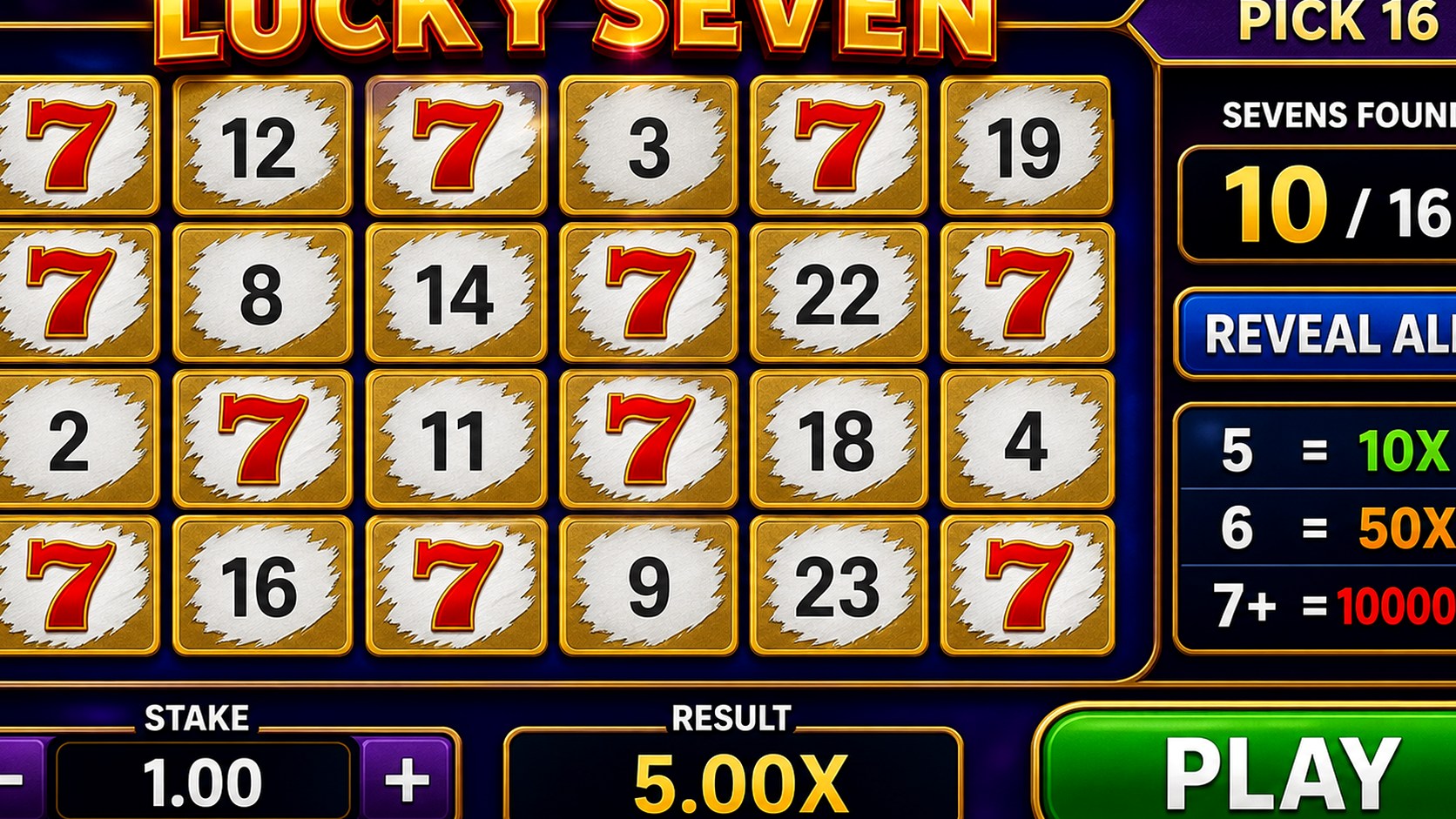
Picture One: Reconstructed Scratch Board

The first picture shows a complete six-by-four scratch board and a separate rules panel. It is a clean teaching reconstruction, not a live Smartsoft round.

The illustration supports visual analysis only and cannot certify probability, balance data or a result.

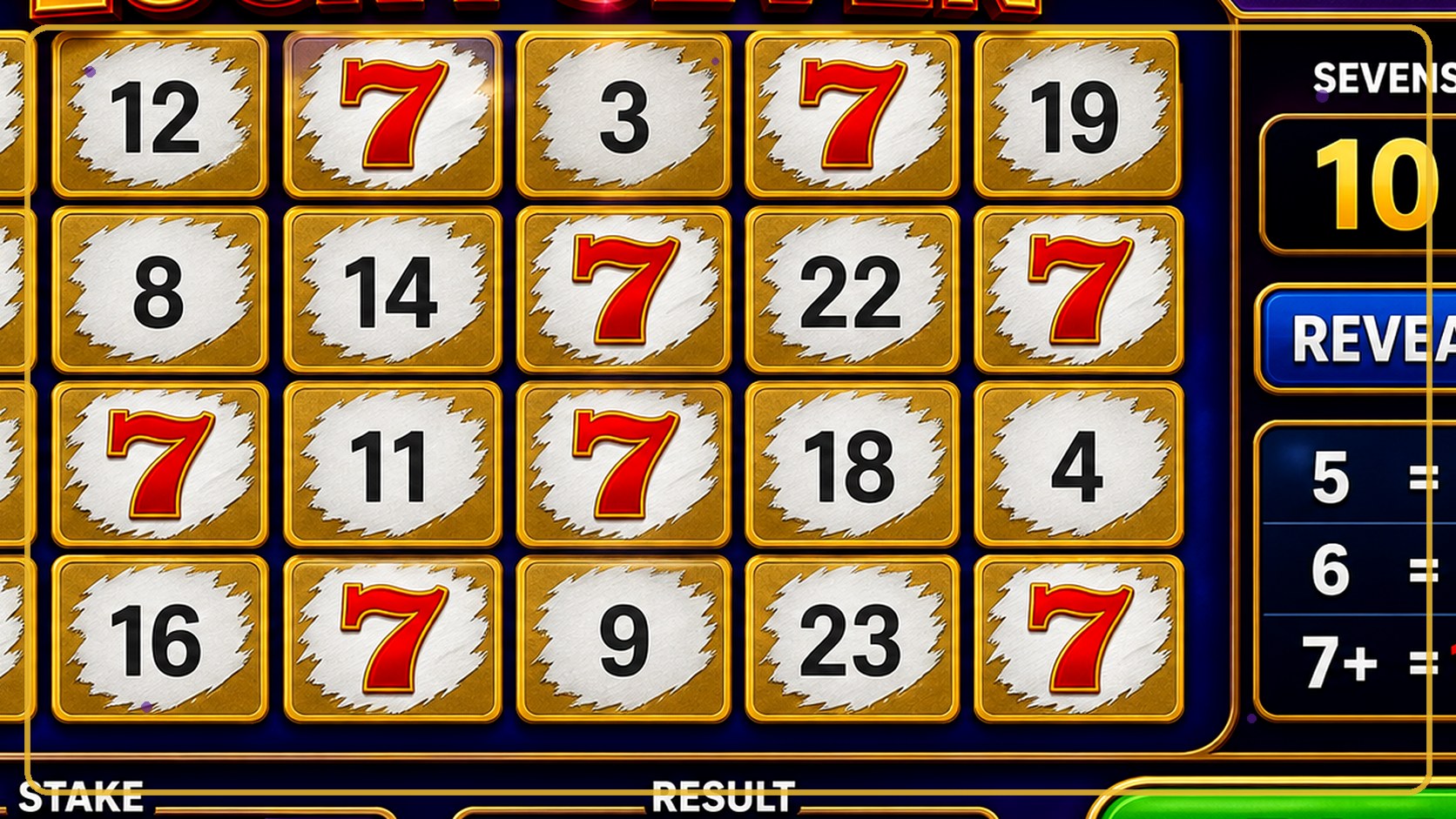
Picture Two: Twenty-Four Positions

The second picture enlarges the covered and revealed positions so the difference between panel count, chosen count and seven count can be discussed.

The closer crop makes the state easier to discuss, while the client history remains the authority for credited components.

Picture Three: Counter and Prize Ladder

The third picture focuses on the counter, prize ladder and Reveal All control. Its numbers are illustrative and do not document a paid result.

The final image maps rules and states but does not assert that the pictured state occurred.

Scratch record 19: Sound Design and Perceived Pace

scratch-card audit can be strengthened through layered music, reel-stop cues and short feature stingers. Sound is useful when it marks a trigger or completed calculation. It becomes less useful when every partial return receives the same fanfare as a clear profit.

Try several rounds with audio lowered. If the board still communicates outcome, the interface is doing its job. If the result becomes ambiguous without a voice line or long count-up, the visual feedback needs more attention. Audio should confirm settlement, not replace the numbers.

Scratch record 20: Landscape Play and Thumb Reach

A horizontal phone gives the dark violet digital scratch-card desk room on both sides of the reels. The central board remains large while settings, stake controls and spin can occupy the lower band. This arrangement works best when the largest button sits away from the minus and plus controls.

Before rapid play, rotate the device, enter full screen and check the total-stake field after one adjustment. Browser bars and system gestures can cover edge controls. A test spin at the minimum setting confirms that the hit boxes match the visible buttons and that no accidental Max Bet control sits beneath the thumb.

Scratch record 21: Portrait Mode Is a Compromise

Portrait layout may scale the entire game down or reorganize controls beneath the grid. Tiny payline markers and condensed help text are the first casualties. The screen can remain playable, yet accurate rule reading becomes harder when the table requires repeated zooming or horizontal swipes.

Use portrait mode for quick navigation, not for the first rules check. Landscape is the better place to compare total stake, balance and win because all three can remain visible together. The relationship between those numbers matters more than keeping the device in one hand.

Scratch record 22: Performance on Mid-Range Phones

The artwork uses multiple layers, large character cutouts and particle effects. On a mid-range handset, watch for delayed button response after a count-up, audio falling out of step with the reels or a stake change taking effect one round late. Those are interface problems, not signs of altered probability.

Close other heavy apps and use a stable connection during the first session. If the client reconnects, verify balance and the last completed round in history before spinning again. A frozen animation can recover after the server has already settled the result, so the account record takes priority over the last visible frame.
Scratch record 23: Stake Controls Deserve More Attention Than the Mascot

The Reveal All control can settle rounds so quickly that turnover becomes hard to feel even though every press carries a fresh stake. The most useful habit is to read total stake after every change and before the first rapid sequence. Bet per line, coin value and total bet may occupy separate fields, and altering one can multiply the final debit.

A planned session should be written in money, spins and time. Divide the session amount by the intended number of paid rounds to find a workable average stake. Free actions do not add a new debit unless the client states a purchase. This arithmetic is dull, but it controls exposure more reliably than any theme-based hunch.

Scratch record 24: RTP Belongs to Turnover, Not a Short Run

Once the deployed RTP is known, interpret it as a long-run model ratio. If the help page lists 96 percent, theoretical cost is four units per hundred units of turnover. That sentence is an example of the calculation, not a claim that this version uses 96 percent.

Turnover equals total paid stake across accepted rounds. A hundred spins at one unit create one hundred units of turnover even if several free actions appear between them. A short session may finish far above or below the model ratio because random outcomes do not settle into a neat percentage on demand.

Scratch record 25: Volatility Is About Distribution

Volatility describes how payout value is spread across outcomes. A higher band usually places more weight in less common large results; a lower band usually returns more of its value through smaller payments. The label does not state when a feature will arrive or how long a losing sequence can last.

Without an official band, infer nothing from scratch-card audit. A calm fruit village can use severe math, and a battlefield can use a mild distribution. After the label is found, use it to size stake and session length, not to forecast the next reel stop.

Scratch record 26: Maximum Win Needs a Denominator

A 10,000-times headline is large enough that the denominator and exact symbol count cannot be omitted. The help page must state how many sevens are required and if a fixed cash cap overrides the ratio.

Do not assume that 7+ automatically means the top award merely because an editorial illustration uses that shorthand. The illustration is not the paytable.

Scratch record 27: A Clean Demo Test in Thirty Paid Rounds

Use the minimum fixed stake and create one row for each paid round. Record starting balance, debit, base credit, feature credit, ending balance and any meter change. Keep free actions inside the row of the spin that triggered them. This format exposes the money flow without treating a tiny sample as statistical proof.

Thirty rounds are enough to learn button behavior, symbol settlement and feature messages. They are not enough to estimate RTP or trigger frequency. The purpose is mechanical literacy. Stop the test once each major control has been checked; more spins do not turn an informal sample into certification.

Scratch record 28: How to Audit a Bonus From Start to Finish

Capture the trigger screen, starting counter, carried stake and opening multiplier. Then note each retrigger, held symbol, expanding reel or meter reset. At the end, compare the feature total with the history record and final balance. Every free action should trace back to one paid round.

If a purchase button exists, treat it as a separate bet mode. Record its price as the full stake for that round and read its RTP entry independently if the client lists one. A purchased feature may use the same animation while carrying a different cost structure.

Scratch record 29: Common Misreads Around Lucky Seven

The first misread is assuming that Seven states the unconditional top award. The second is assigning premium status solely from symbol size. The third is treating a filling Pick 16 counter and Sevens Found total as proof that a feature is due. The fourth is calling every substitute a multiplier Wild without checking the rules.

The fifth is copying an RTP from an unrelated review. The sixth is counting free actions as fresh paid spins. The seventh is judging profit from the win banner instead of balance movement. Each mistake disappears when the player keeps the stake field, history panel and help page in the same audit.

Scratch record 30: What Philippine Players Should Verify

A Philippine listing may use peso values, wallet credits or a converted coin display. Confirm the minimum and maximum total stake, not merely coin size. Check that the operator names Smartsoft Gaming as the studio, and compare the logo with the official key art before assuming that a similarly named title is the same product.

Also read local rules for feature purchases, autoplay, session reminders and cash limits. These controls belong to the operator build and jurisdiction. A screenshot from another market can explain layout, but it cannot establish the available stake range or certified return in a Philippine account.

Scratch record 31: Who Gets the Most From This Theme

Readers who prefer one completed reveal decision over spinning reels, paylines, Wilds and free-spin counters will find the presentation immediately legible. The theme also suits short review sessions because the visual hierarchy can be judged quickly. That does not make the mathematical profile suitable for every budget; the actual volatility and minimum total stake still control that decision.

Anyone who dislikes dense side art or loud event effects should test the sound and fast-play controls first. A strong theme can be a reason to open a demo, but it is not a reason to ignore the paytable. Interest in the artwork and comfort with the stake are separate choices.

Scratch record 32: A Practical Decision Checklist

Before real play, confirm the exact title, studio, RTP, volatility, win method, Wild exceptions, Scatter route, feature trigger, multiplier scope, maximum-win denominator and cash cap. Then set a total session amount and a stopping time. If any critical rule remains hidden, keep the title in demo mode.

During play, watch balance rather than animation. After play, compare opening balance, deposits, withdrawals and ending balance with the history log. This checklist does not change random results. It changes how clearly the cost and settlement can be seen.

Scratch record 33: Final Reading: Theme First, Math Before Money

Lucky Seven should be reviewed as a compact instant game. The real questions are how many panels are chosen, when the outcome is fixed, how sevens map to the prize ladder and which return version the operator has deployed

Lucky Seven earns attention through scratch-card audit and a tightly coordinated deep violet, midnight blue, bright gold and signal red palette. The next step is not a larger stake; it is the local information screen. Confirm the deployed math, test the controls at minimum value and treat every visual promise as a question that the rules must answer.

Scratch record 34: Separating Hit Rate From Profit Rate

A hit is any result the rules count as a payment. Profit requires the credited amount to exceed the full stake for that paid round. A title can register frequent small hits while the balance declines. Without an official hit-frequency figure, the only safe statement is that the two rates are not interchangeable.

For a demo log, mark return ratios below 1x, exactly 1x and above 1x in separate columns. This reveals how many recorded wins were partial returns. It still does not predict future play, but it gives a much clearer account of the sample than a simple count of flashing win messages.

Scratch record 35: Near Misses Are Animation, Not Progress

A bonus icon stopping just outside a payline or a premium symbol passing during reel motion can feel meaningful. Unless the written rule stores that event, it has no carry-over value. The next accepted round is not improved because the previous animation looked close.

The same caution applies to two trigger symbols when three are required. They may create suspense, yet their payment and stored effect depend entirely on the table. Record what was credited, then clear the image from the decision about the next stake.

Scratch record 36: Fast Play Changes Exposure Speed

Fast play shortens animation; it does not normally change the random model. Its financial effect comes from time. More paid rounds can fit into the same minute, so the balance may move faster even though the stake per round stays fixed.

Measure pace before enabling it. Ten ordinary rounds on standard speed and ten on fast speed reveal the difference in turnover per minute. If the faster rate breaks the planned session limit, lower the stake or return to standard timing rather than relying on attention alone.

Scratch record 37: Autoplay Needs Stop Conditions

Where autoplay is available, set a round count and use any loss, win or single-award limits shown by the client. Read those fields carefully because some are cash values while others are stake multipliers. An empty field may mean no automatic stop for that condition.

Remain present during automated rounds. Network reconnection, a feature choice or a changed balance can pause the sequence. Autoplay is a convenience control, not a budget system, and it does not make a long sample more likely to follow the theoretical return.

Scratch record 38: Responsible Play in Plain Numbers

Set a sum that can be lost without affecting bills, savings or debt payments. Do not borrow to play, do not chase a prior loss and do not treat a rare large result as income. Time reminders and deposit limits are useful because strong game art can blur the length of a session.

If play stops feeling optional, close the client and use the operator exclusion or limit tools. The clearest review of any slot ends with the same fact: outcomes are random, the house keeps a mathematical margin over long turnover and no visual pattern creates a reliable edge.
By Fairy Editorial - 25 Aug 2026
7 Bonus Up Review: Nine Matching Symbols Open a Very Different Fruit Game
7 Bonus Up
7 Bonus Up Review: Nine Matching Symbols Open a Very Different Fruit Game

7 Bonus Up puts a familiar theme around five paylines, roulette multiplier track and Risk Game attempts. The studio states that nine identical symbols start Fruit Roulette, symbol prizes are collected until the wheel lands on a multiplier, and the accumulated amount can reach a 7-times multiplier. The review follows the actual debit and settlement rules rather than treating the presentation as evidence of value. Endorphina publishes a 3 by 3 game with five paylines, a 96.02 percent return, high volatility, a 0.05 to 40 euro catalogue bet range, Fruit Roulette, Risk Game and a jurisdiction-dependent Bonus Pop option. Exact regional terms remain a client-level fact. The three horizontal pictures are original editorial reconstructions based on Endorphina public information. They are not studio screenshots, records of nine matching symbols or evidence of a roulette multiplier. This article uses a strict evidence order: deployed help screen, studio rule sheet, regulated operator description and independent catalogue. Artwork proves identity and theme only; it cannot prove reel strips, probability, trigger frequency or an operator return setting. No paid wager was placed and no age-confirmation screen was bypassed. Public pages supplied rules but did not expose a complete lawful demo session for direct capture, so there is no claimed personal hit rate, balance result or bonus sample. A reproducible test should record selected stake, starting balance, round identifier, each line or special component, feature entry, counter movement and final credit. That log cannot predict later rounds, but it can expose a misunderstood denominator or reset. Closely related games must be kept separate. Similar fruit, fantasy or cabinet art does not guarantee the same return, feature price, retrigger rule or maximum. The exact title and active help file define the product reviewed here. The three landscape images are explanatory mobile compositions. Values, positions and balances are props and must not be reused as proof of a trigger or win.

For a useful first-session audit, twenty or thirty rounds are too small a sample for probability claims, yet they are enough to inspect interface behavior. Check the spin control after a network pause, the point at which the stake is debited, how line wins are itemized, where the rules open, and If feature counters survive a reconnect. Also confirm that turbo, autoplay and sound controls do not obscure the amount committed per round. These observations say nothing about future results, but they can prevent a display or unit mistake from being mistaken for game mathematics. A second pass should separate entertainment pace from financial pace. Time ten normal rounds at the lowest practical stake, then repeat at the intended stake without changing speed settings. Record total money placed, returned credit, longest blank stretch and the number of interruptions caused by animations or collection screens. The purpose is not to manufacture a strategy. It is to see how quickly the interface can cycle money and to judge If the chosen stake remains comfortable when several quiet rounds arrive together. Cash figures also need context before publication. A multiplier normally refers to the base bet or total round stake defined by the help file, while a displayed jackpot, feature prize or regional currency figure may use a different denominator. Never convert a promotional number into a universal payout promise. Save the local rules and paytable beside the session log, because those two screens are the only defensible reference if the lobby copy, catalogue listing or another operator shows different data.

Opening the Three-by-Three Cabinet

7 Bonus Up opens with compact roulette notebook. The fruit roulette wheel and double-seven symbol and strawberries, lemons, oranges, grapes, cherries, watermelons, stars and BARs are not background ornaments; they form a visual hierarchy that tells the eye where to look before any rule has been read. The reel area sits inside that hierarchy, so symbols remain distinct from the scenery instead of dissolving into it.

That first reading matters on a phone. A slot may spend heavily on illustration and still fail if the stake, spin control or settled result is hard to locate. Here the strongest idea is not mere decoration. It is the way navy, chrome silver, crimson, citrus yellow and emerald separates the game board, framing art and controls into layers.

What the Studio Page Confirms

Endorphina publishes a 3 by 3 game with five paylines, a 96.02 percent return, high volatility, a 0.05 to 40 euro catalogue bet range, Fruit Roulette, Risk Game and a jurisdiction-dependent Bonus Pop option. The studio states that nine identical symbols start Fruit Roulette, symbol prizes are collected until the wheel lands on a multiplier, and the accumulated amount can reach a 7-times multiplier.

These facts define the review frame. Operator help text still ranks first for local stake units, feature availability, return variant and cash cap.

Reading the 96.02 Percent Filing

The official page prints 96.02 percent and high volatility. This combination means a conventional long-run return is distributed unevenly through a very small cabinet.

The number does not indicate when nine matching symbols will appear or which roulette multiplier will end the feature.

Why High Volatility Matters Here

The word Bonus is the headline hook. It raises an obvious question: does it describe a multiplier, a progression, a visual motif or simply the scale of the story? Only the help screen can answer that. A number or power word in a logo is not automatically the highest cash ratio for a paid round.

Before treating the title as a promise, locate the line that defines it. Check the triggering symbols, the stage at which the value applies, any stake multiplier, the cap on simultaneous wins and any separate cash ceiling. If those conditions are absent, the name should remain a marketing label rather than a calculation.

Three Reels, Three Rows, Five Lines

The reconstruction follows the confirmed three-reel, three-row and five-line cabinet. Regional Bonus Pop availability, bet units, cash limits and Risk Game terms must be checked in the active client.

Board dimensions alone do not determine settlement. Direction, match length, line unit, substitution exclusions and simultaneous awards must be read together.

Fruit, Stars, BARs and Double Sevens

The theme naturally divides the reel set into character or object symbols, special icons and ordinary fruit symbols. strawberries, lemons, oranges, grapes, cherries, watermelons, stars and BARs carry more visual weight than the letters and numbers. That weight usually signals premium status, but the paytable may rank two similar objects very differently. Size and shine are clues, never final values.

Read every payout in the unit used by the game. Some tables show bet-per-line units; others use total stake. A five-of-a-kind figure can appear ten or twenty times larger if the unit is misunderstood. The cash meter after a test spin is useful, but the written help panel should settle the conversion.

Ordinary Symbols Before the Roulette

ordinary fruit symbols occupy a large share of ordinary reel time in the editorial layout. They create visual breathing room around the premium art and make small combinations quick to recognize. Their role in the mathematical model may be larger than their small paytable values suggest because frequency and value are separate parts of return.

A low-symbol hit can light the grid while returning less than the amount staked. That is a paid result, not necessarily a profitable round. The correct comparison is final credit divided by the full spin cost. Animation length, coin count and sound volume do not change that ratio.

Following One of Five Lines

Large portraits and objects such as strawberries, lemons, oranges, grapes, cherries, watermelons, stars and BARs can dominate the frame. The practical test is to follow one settled combination from its first symbol to its last without relying on flashing borders. Clear spacing between reels, consistent icon silhouettes and a visible route make the result easier to audit.

If several awards arrive together, open the win breakdown or history panel. One total may contain multiple lines, an anywhere payment and a modifier. Treating the largest symbol on screen as the sole cause can produce a false reading of the rule, especially when a substitute or multiplier is also present.

A Game Without a Conventional Wild

The public feature list does not identify a conventional Wild. That absence matters because ordinary line combinations should be formed by exact symbol matches unless the paytable states another substitute.

Do not transfer Wild rules from other Endorphina fruit titles simply because their visual vocabulary is similar.

Nine Matching Symbols Change the State

Nine symbols of the same kind fill the entire three-by-three screen and start Fruit Roulette. This is a full-board state, not a three-Scatter trigger or a free-spin award.

Ordinary line wins from the triggering screen should be recorded separately from the bonus amount if the history displays both.

The Roulette Settlement Sequence

The roulette lands on fruit or symbol prizes that are added to the running collection. The round ends when the pointer reaches a multiplier.

The final multiplier can reach 7 times according to the studio description. It applies to the accumulated bonus pot under the help rules, not automatically to earlier base-game line wins.

Base Spins Before a Full Screen

Many reviews rush past the paid reels and treat the bonus as the only meaningful part. That misses the money path. Base spins create nearly all turnover, settle small and medium awards, and decide how long a balance remains available. A rare feature cannot repair a stake level that is too high for the intended session.

7 Bonus Up needs ordinary results that are readable at a glance. A clean board lets the user distinguish a no-win, a partial return and a profit without waiting for a long count-up. That clarity is especially important when the surrounding midnight-blue chrome fruit cabinet is busy and the screen uses strong motion.

How Symbol Prizes Accumulate

There are no free spins in the published core description. The main bonus is roulette, followed separately by any optional Risk Game decision after an eligible credit.

Bonus Pop is jurisdiction-dependent. Its price, starting state and return should never be inferred from another operator build.

The Multiplier Ends the Bonus

The roulette multiplier is a closing settlement step. Record the symbol-prize subtotal before the multiplier and the final credit after it.

The Risk Game is another layer with separate odds and loss exposure. A roulette x7 and a later double are not one combined guaranteed multiplier path.

Paytable Entries and the x7 Limit

Clients often label results with tiers such as big, mega or super. Those labels are commonly based on the ratio between win and current stake. They do not prove that the result reached the mathematical ceiling. The count-up may also stop at a cash cap even when the theoretical symbol total is higher.

To calculate a genuine ratio, divide the credited result by the total stake removed for the paid round. Include free follow-up actions inside that same round unless the rules state otherwise. This method turns a loud presentation into a comparable number and avoids confusing coins on screen with peso value.

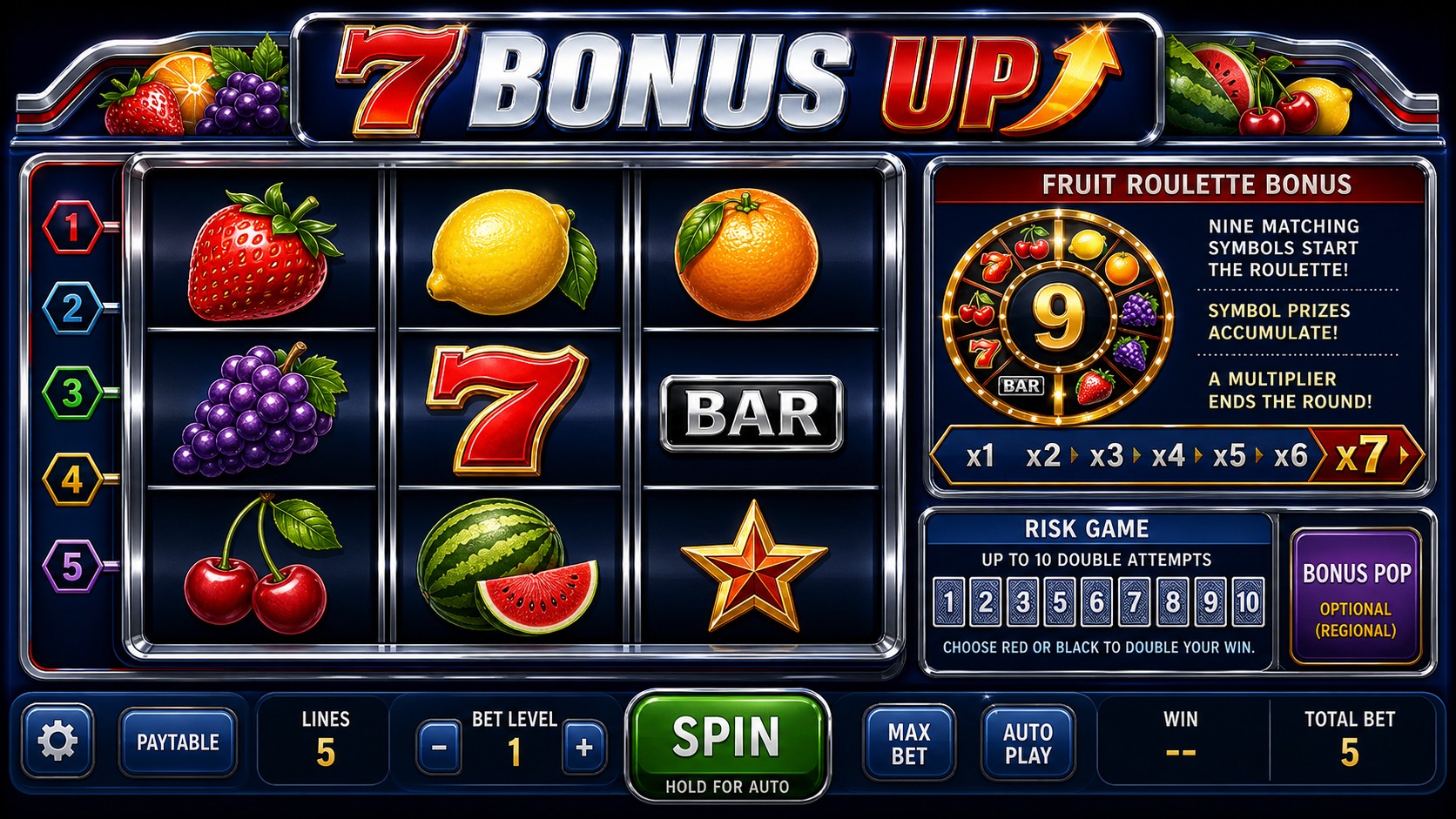
Picture One: Compact Reconstruction

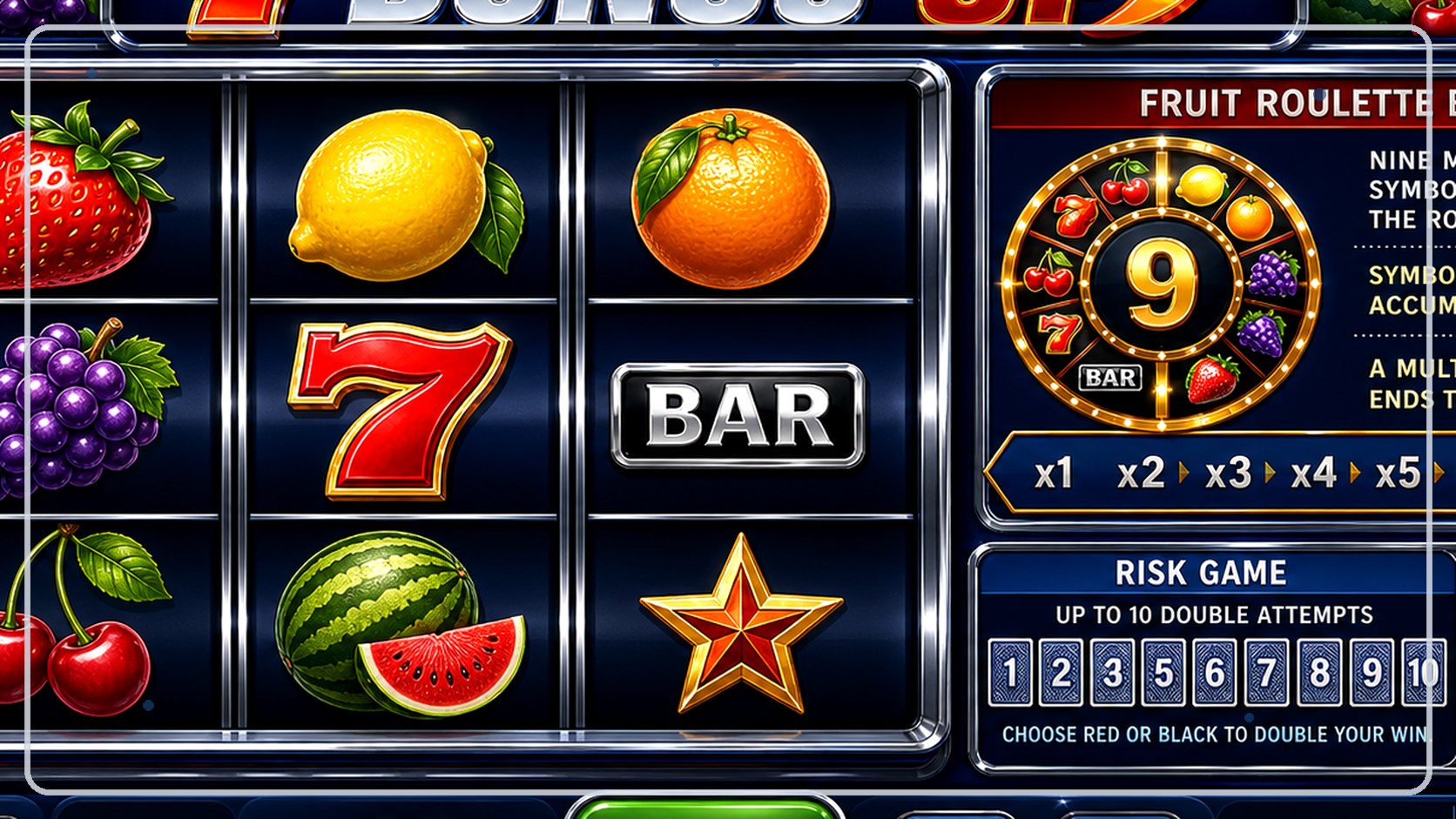
The first picture presents the exact small-board concept beside a rule-oriented roulette panel. It is newly made review art rather than a live game frame.

The illustration supports visual analysis only and cannot certify probability, reel strips, a balance or a result.

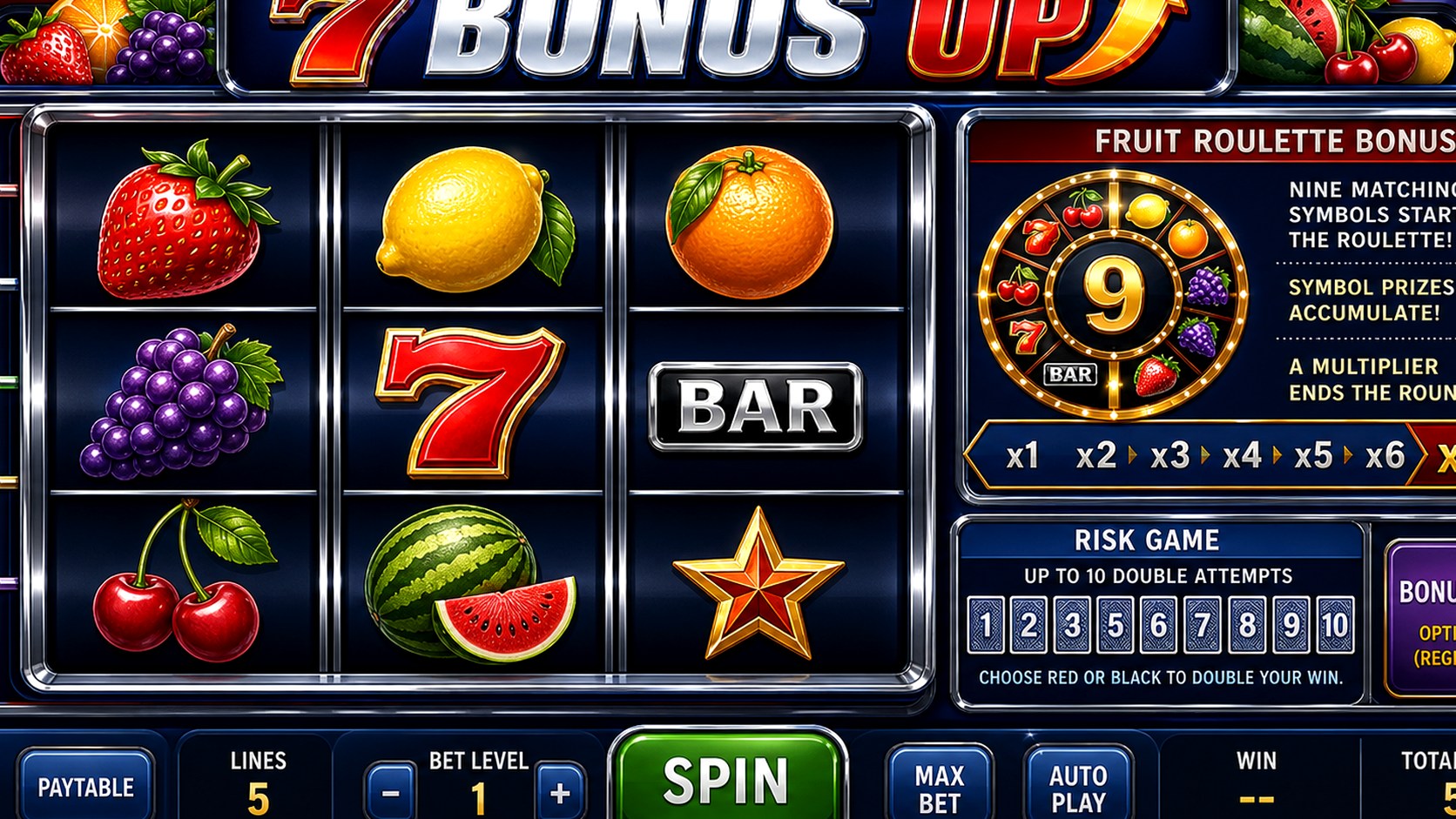
Picture Two: Nine Cells and Five Lines

The second picture moves closer to the nine cells and five line markers. It helps explain how a full-screen match differs from an ordinary three-symbol line.

The closer crop makes symbol roles easier to separate, while the client history remains the authority for credited components.

Picture Three: Roulette and Risk Choices

The third picture enlarges roulette, x7 scale, Risk Game and regional Bonus Pop label. Those elements are explanatory and may not all be enabled in one jurisdiction.

The final image maps rules and states but does not assert that the pictured state occurred.

Fruit docket 19: Sound Design and Perceived Pace

compact roulette notebook can be strengthened through layered music, reel-stop cues and short feature stingers. Sound is useful when it marks a trigger or completed calculation. It becomes less useful when every partial return receives the same fanfare as a clear profit.

Try several rounds with audio lowered. If the board still communicates outcome, the interface is doing its job. If the result becomes ambiguous without a voice line or long count-up, the visual feedback needs more attention. Audio should confirm settlement, not replace the numbers.

Fruit docket 20: Landscape Play and Thumb Reach

A horizontal phone gives the midnight-blue chrome fruit cabinet room on both sides of the reels. The central board remains large while settings, stake controls and spin can occupy the lower band. This arrangement works best when the largest button sits away from the minus and plus controls.

Before rapid play, rotate the device, enter full screen and check the total-stake field after one adjustment. Browser bars and system gestures can cover edge controls. A test spin at the minimum setting confirms that the hit boxes match the visible buttons and that no accidental Max Bet control sits beneath the thumb.

Fruit docket 21: Portrait Mode Is a Compromise

Portrait layout may scale the entire game down or reorganize controls beneath the grid. Tiny payline markers and condensed help text are the first casualties. The screen can remain playable, yet accurate rule reading becomes harder when the table requires repeated zooming or horizontal swipes.

Use portrait mode for quick navigation, not for the first rules check. Landscape is the better place to compare total stake, balance and win because all three can remain visible together. The relationship between those numbers matters more than keeping the device in one hand.

Fruit docket 22: Performance on Mid-Range Phones

The artwork uses multiple layers, large character cutouts and particle effects. On a mid-range handset, watch for delayed button response after a count-up, audio falling out of step with the reels or a stake change taking effect one round late. Those are interface problems, not signs of altered probability.

Close other heavy apps and use a stable connection during the first session. If the client reconnects, verify balance and the last completed round in history before spinning again. A frozen animation can recover after the server has already settled the result, so the account record takes priority over the last visible frame.

Fruit docket 23: Stake Controls Deserve More Attention Than the Mascot

A small board and five lines can look inexpensive, but a high-volatility model and two optional post-result choices can still produce abrupt balance changes. The most useful habit is to read total stake after every change and before the first rapid sequence. Bet per line, coin value and total bet may occupy separate fields, and altering one can multiply the final debit.

A planned session should be written in money, spins and time. Divide the session amount by the intended number of paid rounds to find a workable average stake. Free actions do not add a new debit unless the client states a purchase. This arithmetic is dull, but it controls exposure more reliably than any theme-based hunch.

Fruit docket 24: RTP Belongs to Turnover, Not a Short Run

Once the deployed RTP is known, interpret it as a long-run model ratio. If the help page lists 96 percent, theoretical cost is four units per hundred units of turnover. That sentence is an example of the calculation, not a claim that this version uses 96 percent.

Turnover equals total paid stake across accepted rounds. A hundred spins at one unit create one hundred units of turnover even if several free actions appear between them. A short session may finish far above or below the model ratio because random outcomes do not settle into a neat percentage on demand.

Fruit docket 25: Volatility Is About Distribution

Volatility describes how payout value is spread across outcomes. A higher band usually places more weight in less common large results; a lower band usually returns more of its value through smaller payments. The label does not state when a feature will arrive or how long a losing sequence can last.

Without an official band, infer nothing from compact roulette notebook. A calm fruit village can use severe math, and a battlefield can use a mild distribution. After the label is found, use it to size stake and session length, not to forecast the next reel stop.

Fruit docket 26: Maximum Win Needs a Denominator

Double sevens are the highest listed base symbol at 155 times base bet for three, followed by stars and BARs. These are paytable entries, not the frequency of landing them.

Any larger published maximum needs the deployed rule file, denominator and cash cap. Secondary catalogue claims should not be promoted over the game help screen.

Fruit docket 27: A Clean Demo Test in Thirty Paid Rounds

Use the minimum fixed stake and create one row for each paid round. Record starting balance, debit, base credit, feature credit, ending balance and any meter change. Keep free actions inside the row of the spin that triggered them. This format exposes the money flow without treating a tiny sample as statistical proof.

Thirty rounds are enough to learn button behavior, symbol settlement and feature messages. They are not enough to estimate RTP or trigger frequency. The purpose is mechanical literacy. Stop the test once each major control has been checked; more spins do not turn an informal sample into certification.

Fruit docket 28: How to Audit a Bonus From Start to Finish

Capture the trigger screen, starting counter, carried stake and opening multiplier. Then note each retrigger, held symbol, expanding reel or meter reset. At the end, compare the feature total with the history record and final balance. Every free action should trace back to one paid round.

If a purchase button exists, treat it as a separate bet mode. Record its price as the full stake for that round and read its RTP entry independently if the client lists one. A purchased feature may use the same animation while carrying a different cost structure.

Fruit docket 29: Common Misreads Around 7 Bonus Up

The first misread is assuming that Bonus states the unconditional top award. The second is assigning premium status solely from symbol size. The third is treating a filling five paylines, roulette multiplier track and Risk Game attempts as proof that a feature is due. The fourth is calling every substitute a multiplier Wild without checking the rules.

The fifth is copying an RTP from an unrelated review. The sixth is counting free actions as fresh paid spins. The seventh is judging profit from the win banner instead of balance movement. Each mistake disappears when the player keeps the stake field, history panel and help page in the same audit.

Fruit docket 30: What Philippine Players Should Verify

A Philippine listing may use peso values, wallet credits or a converted coin display. Confirm the minimum and maximum total stake, not merely coin size. Check that the operator names Endorphina as the studio, and compare the logo with the official key art before assuming that a similarly named title is the same product.

Also read local rules for feature purchases, autoplay, session reminders and cash limits. These controls belong to the operator build and jurisdiction. A screenshot from another market can explain layout, but it cannot establish the available stake range or certified return in a Philippine account.

Fruit docket 31: Who Gets the Most From This Theme

Readers who prefer a compact three-by-three cabinet where the main distinction comes from a rare full-screen trigger rather than free spins will find the presentation immediately legible. The theme also suits short review sessions because the visual hierarchy can be judged quickly. That does not make the mathematical profile suitable for every budget; the actual volatility and minimum total stake still control that decision.

Anyone who dislikes dense side art or loud event effects should test the sound and fast-play controls first. A strong theme can be a reason to open a demo, but it is not a reason to ignore the paytable. Interest in the artwork and comfort with the stake are separate choices.

Fruit docket 32: A Practical Decision Checklist

Before real play, confirm the exact title, studio, RTP, volatility, win method, Wild exceptions, Scatter route, feature trigger, multiplier scope, maximum-win denominator and cash cap. Then set a total session amount and a stopping time. If any critical rule remains hidden, keep the title in demo mode.

During play, watch balance rather than animation. After play, compare opening balance, deposits, withdrawals and ending balance with the history log. This checklist does not change random results. It changes how clearly the cost and settlement can be seen.

Fruit docket 33: Final Reading: Theme First, Math Before Money

7 Bonus Up is a compact fruit machine with an unusual division of labor. The base grid supplies ordinary line awards, the full-screen condition opens roulette, and the later multiplier closes the bonus after symbol prizes have accumulated

7 Bonus Up earns attention through compact roulette notebook and a tightly coordinated navy, chrome silver, crimson, citrus yellow and emerald palette. The next step is not a larger stake; it is the local information screen. Confirm the deployed math, test the controls at minimum value and treat every visual promise as a question that the rules must answer.

Fruit docket 34: Separating Hit Rate From Profit Rate

A hit is any result the rules count as a payment. Profit requires the credited amount to exceed the full stake for that paid round. A title can register frequent small hits while the balance declines. Without an official hit-frequency figure, the only safe statement is that the two rates are not interchangeable.

For a demo log, mark return ratios below 1x, exactly 1x and above 1x in separate columns. This reveals how many recorded wins were partial returns. It still does not predict future play, but it gives a much clearer account of the sample than a simple count of flashing win messages.

Fruit docket 35: Near Misses Are Animation, Not Progress

A bonus icon stopping just outside a payline or a premium symbol passing during reel motion can feel meaningful. Unless the written rule stores that event, it has no carry-over value. The next accepted round is not improved because the previous animation looked close.

The same caution applies to two trigger symbols when three are required. They may create suspense, yet their payment and stored effect depend entirely on the table. Record what was credited, then clear the image from the decision about the next stake.

Fruit docket 36: Fast Play Changes Exposure Speed

Fast play shortens animation; it does not normally change the random model. Its financial effect comes from time. More paid rounds can fit into the same minute, so the balance may move faster even though the stake per round stays fixed.

Measure pace before enabling it. Ten ordinary rounds on standard speed and ten on fast speed reveal the difference in turnover per minute. If the faster rate breaks the planned session limit, lower the stake or return to standard timing rather than relying on attention alone.

Fruit docket 37: Autoplay Needs Stop Conditions

Where autoplay is available, set a round count and use any loss, win or single-award limits shown by the client. Read those fields carefully because some are cash values while others are stake multipliers. An empty field may mean no automatic stop for that condition.

Remain present during automated rounds. Network reconnection, a feature choice or a changed balance can pause the sequence. Autoplay is a convenience control, not a budget system, and it does not make a long sample more likely to follow the theoretical return.

Fruit docket 38: Responsible Play in Plain Numbers

Set a sum that can be lost without affecting bills, savings or debt payments. Do not borrow to play, do not chase a prior loss and do not treat a rare large result as income. Time reminders and deposit limits are useful because strong game art can blur the length of a session.

If play stops feeling optional, close the client and use the operator exclusion or limit tools. The clearest review of any slot ends with the same fact: outcomes are random, the house keeps a mathematical margin over long turnover and no visual pattern creates a reliable edge.
By Fairy Editorial - 25 Aug 2026
The Riot Review: Three Bonus Camps Behind One Ruined City
The Riot
The Riot Review: Three Bonus Camps Behind One Ruined City

The Riot should be judged by three feature routes and the Risk and Buy panel, not by its title alone. Public catalogues commonly list 96.7 percent return, medium volatility and a 5,000-times headline, but other operator pages show conflicting values, so the active help file must settle the deployed version. This review follows debit, state change and settlement instead of treating animation as proof of value. Mascot Gaming describes a five-reel, three-row game with fifteen fixed paylines, two gang-badge Scatter routes, a Survivors trigger and a Risk and Buy path into three different free-spin modes. Exact regional terms remain a client-level fact. All three wide pictures are original editorial reconstructions guided by published rules. They use newly designed characters and emblems and are not Mascot Gaming screenshots, purchase receipts or records of a feature trigger. This article uses a strict evidence order: deployed help screen, studio rule sheet, regulated operator description and independent catalogue. Artwork proves identity and theme only; it cannot prove reel strips, hidden probability, trigger frequency or an operator return setting. No paid wager was placed and no age-confirmation screen was bypassed. Public pages supplied rules but did not expose a complete lawful demo session for direct capture, so there is no claimed personal hit rate, balance result or bonus sample. A reproducible test should record selected stake, starting balance, round identifier, every line or count component, feature entry, counter movement and final credit. That log cannot predict later rounds, but it can expose a misunderstood denominator or reset. Closely related games must be kept separate. Similar fruit, Japanese, apocalypse or Greek artwork does not guarantee the same return, purchase price, retrigger rule or maximum. The exact title and active help file define the product reviewed here. The three landscape images are explanatory mobile compositions. Values, positions and balances are props and must not be reused as proof of a trigger or win. For a useful first-session audit, twenty or thirty rounds are too small a sample for probability claims, yet they are enough to inspect interface behavior. Check the control after a network pause, the point at which the stake is debited, how results are itemized, where the rules open and if feature counters survive a reconnect. These observations cannot forecast outcomes, but they can prevent a display or unit mistake from being mistaken for game mathematics. A second pass should separate entertainment pace from financial pace. Time ten ordinary rounds at the lowest practical stake, then repeat at the intended stake without changing speed settings. Record total money placed, returned credit, longest blank stretch and the number of interruptions caused by animations or collection screens. The purpose is to see how quickly the interface can cycle money. Cash figures need context before publication. A multiplier normally refers to the base amount or total round stake defined by the help file, while a jackpot, feature prize or regional currency figure may use another denominator. Save the local rules and paytable beside the session log because those screens are the defensible reference when listings disagree.

Entering the Ruined District

The Riot opens with post-apocalyptic field report. The masked gang members and armored law enforcers and gang portraits, law badges, skull badges, survivor groups and Wild emblems are not background ornaments; they form a visual hierarchy that tells the eye where to look before any rule has been read. The reel area sits inside that hierarchy, so symbols remain distinct from the scenery instead of dissolving into it.

That first reading matters on a phone. A slot may spend heavily on illustration and still fail if the stake, spin control or settled result is hard to locate. Here the strongest idea is not mere decoration. It is the way charcoal, warning red, police blue, toxic green and dusty orange separates the game board, framing art and controls into layers.

What Mascot Gaming Actually Says

Mascot Gaming describes a five-reel, three-row game with fifteen fixed paylines, two gang-badge Scatter routes, a Survivors trigger and a Risk and Buy path into three different free-spin modes. Public catalogues commonly list 96.7 percent return, medium volatility and a 5,000-times headline, but other operator pages show conflicting values, so the active help file must settle the deployed version.

These facts define the review frame. Operator help text still ranks first for local stake units, feature availability, return variant and cash cap.

Why the Published Numbers Conflict

A 96.7 percent figure appears repeatedly in public catalogues, yet some operator pages list a lower percentage or a different maximum. That conflict is evidence of versioning, not a reason to average the numbers.

Use the return printed inside the running client. The percentage describes long-run turnover under one configuration and cannot forecast a short sequence or a specific bonus route.

Three Camps, Not One Bonus Label

The word Riot is the headline hook. It raises an obvious question: does it describe a multiplier, a progression, a visual motif or simply the scale of the story? Only the help screen can answer that. A number or power word in a logo is not automatically the highest cash ratio for a paid round.

Before treating the title as a promise, locate the line that defines it. Check the triggering symbols, the stage at which the value applies, any stake multiplier, the cap on simultaneous wins and any separate cash ceiling. If those conditions are absent, the name should remain a marketing label rather than a calculation.

Five Reels and Fifteen Fixed Routes

The reconstruction follows the widely reported five-by-three board and fifteen fixed paylines. Local stake range, return setting, feature purchase terms and maximum award remain operator-level facts.

Board dimensions alone do not settle a result. Direction, match length, units, substitution exclusions and simultaneous awards must be read together, except in Lucky Seven where the ticket uses symbol count instead of routes.

Gang Portraits, Badges and Survivors

The theme naturally divides the reel set into character or object symbols, special icons and gang and equipment symbols. gang portraits, law badges, skull badges, survivor groups and Wild emblems carry more visual weight than the letters and numbers. That weight usually signals premium status, but the paytable may rank two similar objects very differently. Size and shine are clues, never final values.

Read every payout in the unit used by the game. Some tables show bet-per-line units; others use total stake. A five-of-a-kind figure can appear ten or twenty times larger if the unit is misunderstood. The cash meter after a test spin is useful, but the written help panel should settle the conversion.

Reading the Ordinary Symbol Ladder

gang and equipment symbols occupy a large share of ordinary reel time in the editorial layout. They create visual breathing room around the premium art and make small combinations quick to recognize. Their role in the mathematical model may be larger than their small paytable values suggest because frequency and value are separate parts of return.

A low-symbol hit can light the grid while returning less than the amount staked. That is a paid result, not necessarily a profitable round. The correct comparison is final credit divided by the full spin cost. Animation length, coin count and sound volume do not change that ratio.

Tracing a Line Through the Rubble

Large portraits and objects such as gang portraits, law badges, skull badges, survivor groups and Wild emblems can dominate the frame. The practical test is to follow one settled combination from its first symbol to its last without relying on flashing borders. Clear spacing between reels, consistent icon silhouettes and a visible route make the result easier to audit.

If several awards arrive together, open the win breakdown or history panel. One total may contain multiple lines, an anywhere payment and a modifier. Treating the largest symbol on screen as the sole cause can produce a false reading of the rule, especially when a substitute or multiplier is also present.

Wild Behavior Changes by Feature

In ordinary play the Wild substitutes under the paytable rules. Inside Base Camp, law-enforcer appearances can form Wild Reels and a Wild Reel can create a respin with the relevant reel held.

Raze Rave uses a different rule: qualifying gang characters become sticky Wilds. Calling both events Wild expansion erases the distinction that determines how the board persists.

Two Scatter Badges Need Separate Rules

The Law badge and Raze badge are separate Scatter symbols commonly reported on the middle reels. Three Law badges enter Base Camp, while three Raze badges enter Raze Rave.

Survivors use a symbol-count condition instead of one of those badge routes. History should identify which trigger fired so the correct feature rules are applied.

The Risk and Buy Decision Screen

Risk and Buy can expose a route after a paid round even when the natural trigger did not appear. Buying sets a separate price; risking can forfeit value while attempting to reach a chosen feature.

Read the exact price, available choices, return entry and maximum before confirming. A menu of three bonuses does not mean equal probability or equal expected return.

Paid Spins Before Any Camp Opens

Many reviews rush past the paid reels and treat the bonus as the only meaningful part. That misses the money path. Base spins create nearly all turnover, settle small and medium awards, and decide how long a balance remains available. A rare feature cannot repair a stake level that is too high for the intended session.

The Riot needs ordinary results that are readable at a glance. A clean board lets the user distinguish a no-win, a partial return and a profit without waiting for a long count-up. That clarity is especially important when the surrounding ruined city divided between rival survivor groups is busy and the screen uses strong motion.

Base Camp and Its Wild Reels

Base Camp is commonly described as ten free spins with law characters acting as Wild Reels. A qualifying Wild Reel can award a respin while that reel remains sticky for the respin state.

Record the starting spin count, held reel, respin debit of zero and final feature total. A held reel is temporary game state, not account credit.

Raze Rave and Sticky Gang Members

Raze Rave changes the matching gang members into sticky Wilds during its free-spin sequence. Stickiness concerns persistence across feature actions; it is not automatically a multiplier.

The Survivors route begins from four or more survivor symbols and uses the award schedule shown in the deployed paytable. Do not combine its count rule with either gang badge trigger.

Survivor Counts and the Award Ceiling

Clients often label results with tiers such as big, mega or super. Those labels are commonly based on the ratio between win and current stake. They do not prove that the result reached the mathematical ceiling. The count-up may also stop at a cash cap even when the theoretical symbol total is higher.

To calculate a genuine ratio, divide the credited result by the total stake removed for the paid round. Include free follow-up actions inside that same round unless the rules state otherwise. This method turns a loud presentation into a comparable number and avoids confusing coins on screen with peso value.

Picture One: Reconstructed District

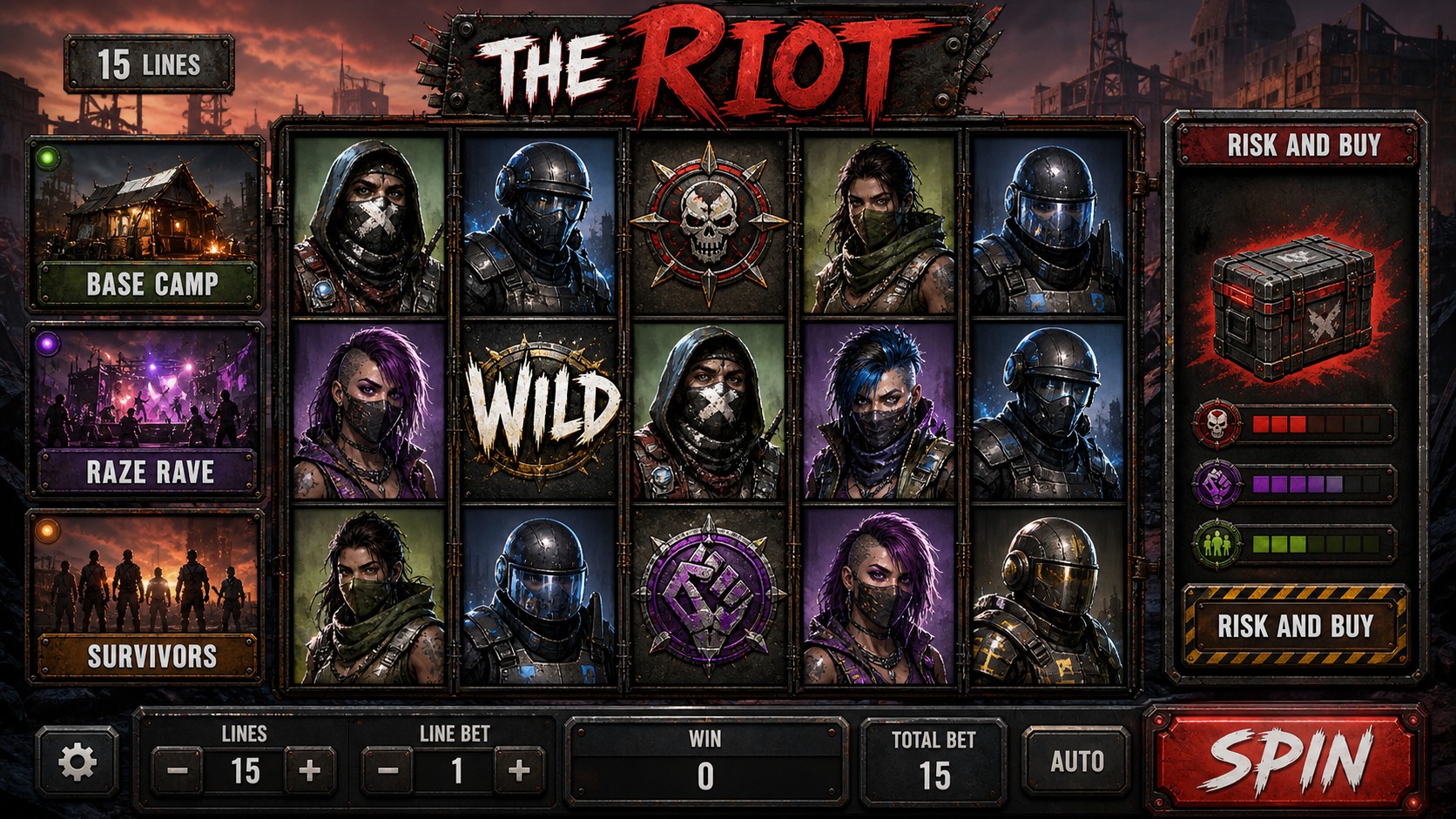
The first picture establishes the ruined city, five-reel board and three named routes in one landscape frame. It is explanatory art rather than a captured client.

The illustration supports visual analysis only and cannot certify probability, balance data or a result.

Picture Two: Gang and Wild Close-Up

The second picture moves closer to gang portraits, badges and the Wild tile. It helps separate character symbols from trigger badges without claiming a settled line.

The closer crop makes the state easier to discuss, while the client history remains the authority for credited components.

Picture Three: Three Routes on One Screen

The third picture emphasizes Base Camp, Raze Rave, Survivors and Risk and Buy. The meters and values are interface props, not an observed purchase or win.

The final image maps rules and states but does not assert that the pictured state occurred.

Riot dispatch 19: Sound Design and Perceived Pace

post-apocalyptic field report can be strengthened through layered music, reel-stop cues and short feature stingers. Sound is useful when it marks a trigger or completed calculation. It becomes less useful when every partial return receives the same fanfare as a clear profit.

Try several rounds with audio lowered. If the board still communicates outcome, the interface is doing its job. If the result becomes ambiguous without a voice line or long count-up, the visual feedback needs more attention. Audio should confirm settlement, not replace the numbers.

Riot dispatch 20: Landscape Play and Thumb Reach

A horizontal phone gives the ruined city divided between rival survivor groups room on both sides of the reels. The central board remains large while settings, stake controls and spin can occupy the lower band. This arrangement works best when the largest button sits away from the minus and plus controls.

Before rapid play, rotate the device, enter full screen and check the total-stake field after one adjustment. Browser bars and system gestures can cover edge controls. A test spin at the minimum setting confirms that the hit boxes match the visible buttons and that no accidental Max Bet control sits beneath the thumb.

Riot dispatch 21: Portrait Mode Is a Compromise

Portrait layout may scale the entire game down or reorganize controls beneath the grid. Tiny payline markers and condensed help text are the first casualties. The screen can remain playable, yet accurate rule reading becomes harder when the table requires repeated zooming or horizontal swipes.

Use portrait mode for quick navigation, not for the first rules check. Landscape is the better place to compare total stake, balance and win because all three can remain visible together. The relationship between those numbers matters more than keeping the device in one hand.

Riot dispatch 22: Performance on Mid-Range Phones

The artwork uses multiple layers, large character cutouts and particle effects. On a mid-range handset, watch for delayed button response after a count-up, audio falling out of step with the reels or a stake change taking effect one round late. Those are interface problems, not signs of altered probability.

Close other heavy apps and use a stable connection during the first session. If the client reconnects, verify balance and the last completed round in history before spinning again. A frozen animation can recover after the server has already settled the result, so the account record takes priority over the last visible frame.

Riot dispatch 23: Stake Controls Deserve More Attention Than the Mascot

Three feature names and a purchase-or-risk decision can make the lobby feel more predictable than the random trigger model actually is. The most useful habit is to read total stake after every change and before the first rapid sequence. Bet per line, coin value and total bet may occupy separate fields, and altering one can multiply the final debit.

A planned session should be written in money, spins and time. Divide the session amount by the intended number of paid rounds to find a workable average stake. Free actions do not add a new debit unless the client states a purchase. This arithmetic is dull, but it controls exposure more reliably than any theme-based hunch.

Riot dispatch 24: RTP Belongs to Turnover, Not a Short Run

Once the deployed RTP is known, interpret it as a long-run model ratio. If the help page lists 96 percent, theoretical cost is four units per hundred units of turnover. That sentence is an example of the calculation, not a claim that this version uses 96 percent.

Turnover equals total paid stake across accepted rounds. A hundred spins at one unit create one hundred units of turnover even if several free actions appear between them. A short session may finish far above or below the model ratio because random outcomes do not settle into a neat percentage on demand.

Riot dispatch 25: Volatility Is About Distribution

Volatility describes how payout value is spread across outcomes. A higher band usually places more weight in less common large results; a lower band usually returns more of its value through smaller payments. The label does not state when a feature will arrive or how long a losing sequence can last.

Without an official band, infer nothing from post-apocalyptic field report. A calm fruit village can use severe math, and a battlefield can use a mild distribution. After the label is found, use it to size stake and session length, not to forecast the next reel stop.

Riot dispatch 26: Maximum Win Needs a Denominator

Public maximum claims range widely, including 750, 1,500 and 5,000 times in different directories. This article treats none of them as universal.

The client must state the cap for natural play and for each Risk and Buy route, plus any fixed cash ceiling. The same artwork can sit above different certified math.

Riot dispatch 27: A Clean Demo Test in Thirty Paid Rounds

Use the minimum fixed stake and create one row for each paid round. Record starting balance, debit, base credit, feature credit, ending balance and any meter change. Keep free actions inside the row of the spin that triggered them. This format exposes the money flow without treating a tiny sample as statistical proof.

Thirty rounds are enough to learn button behavior, symbol settlement and feature messages. They are not enough to estimate RTP or trigger frequency. The purpose is mechanical literacy. Stop the test once each major control has been checked; more spins do not turn an informal sample into certification.

Riot dispatch 28: How to Audit a Bonus From Start to Finish

Capture the trigger screen, starting counter, carried stake and opening multiplier. Then note each retrigger, held symbol, expanding reel or meter reset. At the end, compare the feature total with the history record and final balance. Every free action should trace back to one paid round.

If a purchase button exists, treat it as a separate bet mode. Record its price as the full stake for that round and read its RTP entry independently if the client lists one. A purchased feature may use the same animation while carrying a different cost structure.

Riot dispatch 29: Common Misreads Around The Riot

The first misread is assuming that Riot states the unconditional top award. The second is assigning premium status solely from symbol size. The third is treating a filling three feature routes and the Risk and Buy panel as proof that a feature is due. The fourth is calling every substitute a multiplier Wild without checking the rules.

The fifth is copying an RTP from an unrelated review. The sixth is counting free actions as fresh paid spins. The seventh is judging profit from the win banner instead of balance movement. Each mistake disappears when the player keeps the stake field, history panel and help page in the same audit.

Riot dispatch 30: What Philippine Players Should Verify

A Philippine listing may use peso values, wallet credits or a converted coin display. Confirm the minimum and maximum total stake, not merely coin size. Check that the operator names Mascot Gaming as the studio, and compare the logo with the official key art before assuming that a similarly named title is the same product.

Also read local rules for feature purchases, autoplay, session reminders and cash limits. These controls belong to the operator build and jurisdiction. A screenshot from another market can explain layout, but it cannot establish the available stake range or certified return in a Philippine account.

Riot dispatch 31: Who Gets the Most From This Theme

Readers who want several mechanically different bonus routes instead of one generic free-spin screen will find the presentation immediately legible. The theme also suits short review sessions because the visual hierarchy can be judged quickly. That does not make the mathematical profile suitable for every budget; the actual volatility and minimum total stake still control that decision.

Anyone who dislikes dense side art or loud event effects should test the sound and fast-play controls first. A strong theme can be a reason to open a demo, but it is not a reason to ignore the paytable. Interest in the artwork and comfort with the stake are separate choices.

Riot dispatch 32: A Practical Decision Checklist

Before real play, confirm the exact title, studio, RTP, volatility, win method, Wild exceptions, Scatter route, feature trigger, multiplier scope, maximum-win denominator and cash cap. Then set a total session amount and a stopping time. If any critical rule remains hidden, keep the title in demo mode.

During play, watch balance rather than animation. After play, compare opening balance, deposits, withdrawals and ending balance with the history log. This checklist does not change random results. It changes how clearly the cost and settlement can be seen.

Riot dispatch 33: Final Reading: Theme First, Math Before Money

The Riot earns its identity through three separate bonus routes, but the feature menu also creates its main hazard: every option needs its own cost, Wild behavior, retrigger rule and cap checked before money is committed

The Riot earns attention through post-apocalyptic field report and a tightly coordinated charcoal, warning red, police blue, toxic green and dusty orange palette. The next step is not a larger stake; it is the local information screen. Confirm the deployed math, test the controls at minimum value and treat every visual promise as a question that the rules must answer.

Riot dispatch 34: Separating Hit Rate From Profit Rate

A hit is any result the rules count as a payment. Profit requires the credited amount to exceed the full stake for that paid round. A title can register frequent small hits while the balance declines. Without an official hit-frequency figure, the only safe statement is that the two rates are not interchangeable.

For a demo log, mark return ratios below 1x, exactly 1x and above 1x in separate columns. This reveals how many recorded wins were partial returns. It still does not predict future play, but it gives a much clearer account of the sample than a simple count of flashing win messages.

Riot dispatch 35: Near Misses Are Animation, Not Progress

A bonus icon stopping just outside a payline or a premium symbol passing during reel motion can feel meaningful. Unless the written rule stores that event, it has no carry-over value. The next accepted round is not improved because the previous animation looked close.

The same caution applies to two trigger symbols when three are required. They may create suspense, yet their payment and stored effect depend entirely on the table. Record what was credited, then clear the image from the decision about the next stake.

Riot dispatch 36: Fast Play Changes Exposure Speed

Fast play shortens animation; it does not normally change the random model. Its financial effect comes from time. More paid rounds can fit into the same minute, so the balance may move faster even though the stake per round stays fixed.

Measure pace before enabling it. Ten ordinary rounds on standard speed and ten on fast speed reveal the difference in turnover per minute. If the faster rate breaks the planned session limit, lower the stake or return to standard timing rather than relying on attention alone.

Riot dispatch 37: Autoplay Needs Stop Conditions

Where autoplay is available, set a round count and use any loss, win or single-award limits shown by the client. Read those fields carefully because some are cash values while others are stake multipliers. An empty field may mean no automatic stop for that condition.

Remain present during automated rounds. Network reconnection, a feature choice or a changed balance can pause the sequence. Autoplay is a convenience control, not a budget system, and it does not make a long sample more likely to follow the theoretical return.

Riot dispatch 38: Responsible Play in Plain Numbers

Set a sum that can be lost without affecting bills, savings or debt payments. Do not borrow to play, do not chase a prior loss and do not treat a rare large result as income. Time reminders and deposit limits are useful because strong game art can blur the length of a session.

If play stops feeling optional, close the client and use the operator exclusion or limit tools. The clearest review of any slot ends with the same fact: outcomes are random, the house keeps a mathematical margin over long turnover and no visual pattern creates a reliable edge.
By Fairy Editorial - 24 Aug 2026
2020 Hit Slot Review: One Hundred Lines Behind a Red-Carpet Fruit Machine
2020 Hit Slot
2020 Hit Slot Review: One Hundred Lines Behind a Red-Carpet Fruit Machine

2020 Hit Slot puts a familiar theme around one-hundred-line cabinet and post-win risk panel. The studio lists five trophy Scatters at 500 times base bet and five 2020 Wilds at 10 times base bet, but those symbol entries must be read in the paytable units shown by the deployed client. The review follows the actual debit and settlement rules rather than treating the presentation as evidence of value. Endorphina publishes a 5 by 4 cabinet with 100 fixed paylines, a 96.07 percent return, low volatility, a 1 to 200 euro catalogue bet range, the 2020 symbol as Wild, a trophy Scatter and a classic Risk Game. Exact regional terms remain a client-level fact. All three landscape pictures are original editorial reconstructions based on Endorphina public rules. They are not Endorphina screenshots, paid results or proof that a stacked Wild or trophy appeared. This article uses a strict evidence order: deployed help screen, studio rule sheet, regulated operator description and independent catalogue. Artwork proves identity and theme only; it cannot prove reel strips, probability, trigger frequency or an operator return setting. No paid wager was placed and no age-confirmation screen was bypassed. Public pages supplied rules but did not expose a complete lawful demo session for direct capture, so there is no claimed personal hit rate, balance result or bonus sample. A reproducible test should record selected stake, starting balance, round identifier, each line or special component, feature entry, counter movement and final credit. That log cannot predict later rounds, but it can expose a misunderstood denominator or reset. Closely related games must be kept separate. Similar fruit, fantasy or cabinet art does not guarantee the same return, feature price, retrigger rule or maximum. The exact title and active help file define the product reviewed here. The three landscape images are explanatory mobile compositions. Values, positions and balances are props and must not be reused as proof of a trigger or win.

For a useful first-session audit, twenty or thirty rounds are too small a sample for probability claims, yet they are enough to inspect interface behavior. Check the spin control after a network pause, the point at which the stake is debited, how line wins are itemized, where the rules open, and If feature counters survive a reconnect. Also confirm that turbo, autoplay and sound controls do not obscure the amount committed per round. These observations say nothing about future results, but they can prevent a display or unit mistake from being mistaken for game mathematics. A second pass should separate entertainment pace from financial pace. Time ten normal rounds at the lowest practical stake, then repeat at the intended stake without changing speed settings. Record total money placed, returned credit, longest blank stretch and the number of interruptions caused by animations or collection screens. The purpose is not to manufacture a strategy. It is to see how quickly the interface can cycle money and to judge If the chosen stake remains comfortable when several quiet rounds arrive together. Cash figures also need context before publication. A multiplier normally refers to the base bet or total round stake defined by the help file, while a displayed jackpot, feature prize or regional currency figure may use a different denominator. Never convert a promotional number into a universal payout promise. Save the local rules and paytable beside the session log, because those two screens are the only defensible reference if the lobby copy, catalogue listing or another operator shows different data.

Before the Red Carpet Opens

2020 Hit Slot opens with red-carpet settlement audit. The stacked 2020 Wild numbers and cherries, lemons, oranges, plums, grapes, watermelons and a gold trophy Scatter are not background ornaments; they form a visual hierarchy that tells the eye where to look before any rule has been read. The reel area sits inside that hierarchy, so symbols remain distinct from the scenery instead of dissolving into it.

That first reading matters on a phone. A slot may spend heavily on illustration and still fail if the stake, spin control or settled result is hard to locate. Here the strongest idea is not mere decoration. It is the way black lacquer, deep red, champagne gold and white highlights separates the game board, framing art and controls into layers.

What Endorphina Publishes

Endorphina publishes a 5 by 4 cabinet with 100 fixed paylines, a 96.07 percent return, low volatility, a 1 to 200 euro catalogue bet range, the 2020 symbol as Wild, a trophy Scatter and a classic Risk Game. The studio lists five trophy Scatters at 500 times base bet and five 2020 Wilds at 10 times base bet, but those symbol entries must be read in the paytable units shown by the deployed client.

These facts define the review frame. Operator help text still ranks first for local stake units, feature availability, return variant and cash cap.

Reading the 96.07 Percent Setting

Endorphina lists 96.07 percent and low volatility for the catalogue version. The percentage is a long-run model for one certified configuration, not a session score.

Low volatility does not remove loss risk. It usually means the modeled return is distributed through more modest outcomes, while the house edge remains present on every accepted round.

A Hit Is a Theme, Not a Forecast

The word Hit is the headline hook. It raises an obvious question: does it describe a multiplier, a progression, a visual motif or simply the scale of the story? Only the help screen can answer that. A number or power word in a logo is not automatically the highest cash ratio for a paid round.

Before treating the title as a promise, locate the line that defines it. Check the triggering symbols, the stage at which the value applies, any stake multiplier, the cap on simultaneous wins and any separate cash ceiling. If those conditions are absent, the name should remain a marketing label rather than a calculation.

Five Reels, Four Rows, One Hundred Lines

The art follows the confirmed five-reel, four-row and one-hundred-line structure. The operator information panel remains authoritative for local stake limits, return configuration, cash ceiling and Risk Game availability.

Board dimensions alone do not determine settlement. Direction, match length, line unit, substitution exclusions and simultaneous awards must be read together.

Fruit, Trophy and 2020 Symbols

The theme naturally divides the reel set into character or object symbols, special icons and small fruit symbols. cherries, lemons, oranges, plums, grapes, watermelons and a gold trophy Scatter carry more visual weight than the letters and numbers. That weight usually signals premium status, but the paytable may rank two similar objects very differently. Size and shine are clues, never final values.

Read every payout in the unit used by the game. Some tables show bet-per-line units; others use total stake. A five-of-a-kind figure can appear ten or twenty times larger if the unit is misunderstood. The cash meter after a test spin is useful, but the written help panel should settle the conversion.

Small Fruit Across Many Routes

small fruit symbols occupy a large share of ordinary reel time in the editorial layout. They create visual breathing room around the premium art and make small combinations quick to recognize. Their role in the mathematical model may be larger than their small paytable values suggest because frequency and value are separate parts of return.

A low-symbol hit can light the grid while returning less than the amount staked. That is a paid result, not necessarily a profitable round. The correct comparison is final credit divided by the full spin cost. Animation length, coin count and sound volume do not change that ratio.

Tracing One Fixed Payline

Large portraits and objects such as cherries, lemons, oranges, plums, grapes, watermelons and a gold trophy Scatter can dominate the frame. The practical test is to follow one settled combination from its first symbol to its last without relying on flashing borders. Clear spacing between reels, consistent icon silhouettes and a visible route make the result easier to audit.

If several awards arrive together, open the win breakdown or history panel. One total may contain multiple lines, an anywhere payment and a modifier. Treating the largest symbol on screen as the sole cause can produce a false reading of the rule, especially when a substitute or multiplier is also present.

How the 2020 Wild Substitutes

The 2020 number substitutes for every regular symbol but not the trophy Scatter. Public material also says the symbol may appear stacked.

A stack can participate in several fixed routes at once. Each route still settles independently, and only the valid paytable component should be added to the round total.

The Trophy Pays Anywhere

The trophy counts at any position and does not need to follow a payline. Five trophies are listed at 500 times base bet in the studio symbol description.

Scatter credit is added to line wins. Its base-bet denominator must be distinguished from a per-line stake or total debit before the figure is compared with the round cost.

One Hundred Lines on a Phone Screen

One hundred fixed lines are always part of the cabinet structure. The stake control should show if the displayed selection is total bet or a value multiplied across all routes.

History should list every contributing line or group them transparently. A dense animation is not a substitute for a reconciled component total.

Base Spins Carry the Whole Model

Many reviews rush past the paid reels and treat the bonus as the only meaningful part. That misses the money path. Base spins create nearly all turnover, settle small and medium awards, and decide how long a balance remains available. A rare feature cannot repair a stake level that is too high for the intended session.

2020 Hit Slot needs ordinary results that are readable at a glance. A clean board lets the user distinguish a no-win, a partial return and a profit without waiting for a long count-up. That clarity is especially important when the surrounding black-and-gold awards hall with a red carpet is busy and the screen uses strong motion.

The Risk Game Is a New Decision

The Risk Game begins only after an eligible settled win and creates a new binary decision. Collect preserves the existing award; gamble exposes it to loss in exchange for a possible increase.

The feature is optional and may be unavailable under regional rules. It does not improve the original spin probability or repair a losing round.

No Bonus Multiplier to Invent

No free-spin or general multiplier mode is published for this title. The mathematical change after a win comes from the separate Risk Game, not a hidden multiplier on the fruit board.

Do not describe stacked Wilds as multipliers unless the paytable says so. They expand substitution coverage, not the value printed beside every line.

Paytable Units and the 500x Trophy Entry

Clients often label results with tiers such as big, mega or super. Those labels are commonly based on the ratio between win and current stake. They do not prove that the result reached the mathematical ceiling. The count-up may also stop at a cash cap even when the theoretical symbol total is higher.

To calculate a genuine ratio, divide the credited result by the total stake removed for the paid round. Include free follow-up actions inside that same round unless the rules state otherwise. This method turns a loud presentation into a comparable number and avoids confusing coins on screen with peso value.

Picture One: Awards-Hall Reconstruction

The first picture places the fruit board and award-hall theme in a wide phone frame. The symbols and balances are explanatory props rather than a captured spin.

The illustration supports visual analysis only and cannot certify probability, reel strips, a balance or a result.

Picture Two: Stacked Number Wild

The second picture enlarges the stacked 2020 Wild and the surrounding fruit. It helps explain substitution across several lines without certifying any particular route.

The closer crop makes symbol roles easier to separate, while the client history remains the authority for credited components.

Picture Three: Trophy and Risk Panel

The third picture focuses on the trophy and double-or-collect panel. It maps two separate rule components and does not document a successful gamble.

The final image maps rules and states but does not assert that the pictured state occurred.

Premiere ledger 19: Sound Design and Perceived Pace

red-carpet settlement audit can be strengthened through layered music, reel-stop cues and short feature stingers. Sound is useful when it marks a trigger or completed calculation. It becomes less useful when every partial return receives the same fanfare as a clear profit.

Try several rounds with audio lowered. If the board still communicates outcome, the interface is doing its job. If the result becomes ambiguous without a voice line or long count-up, the visual feedback needs more attention. Audio should confirm settlement, not replace the numbers.

Premiere ledger 20: Landscape Play and Thumb Reach

A horizontal phone gives the black-and-gold awards hall with a red carpet room on both sides of the reels. The central board remains large while settings, stake controls and spin can occupy the lower band. This arrangement works best when the largest button sits away from the minus and plus controls.

Before rapid play, rotate the device, enter full screen and check the total-stake field after one adjustment. Browser bars and system gestures can cover edge controls. A test spin at the minimum setting confirms that the hit boxes match the visible buttons and that no accidental Max Bet control sits beneath the thumb.

Premiere ledger 21: Portrait Mode Is a Compromise

Portrait layout may scale the entire game down or reorganize controls beneath the grid. Tiny payline markers and condensed help text are the first casualties. The screen can remain playable, yet accurate rule reading becomes harder when the table requires repeated zooming or horizontal swipes.

Use portrait mode for quick navigation, not for the first rules check. Landscape is the better place to compare total stake, balance and win because all three can remain visible together. The relationship between those numbers matters more than keeping the device in one hand.

Premiere ledger 22: Performance on Mid-Range Phones

The artwork uses multiple layers, large character cutouts and particle effects. On a mid-range handset, watch for delayed button response after a count-up, audio falling out of step with the reels or a stake change taking effect one round late. Those are interface problems, not signs of altered probability.

Close other heavy apps and use a stable connection during the first session. If the client reconnects, verify balance and the last completed round in history before spinning again. A frozen animation can recover after the server has already settled the result, so the account record takes priority over the last visible frame.

Premiere ledger 23: Stake Controls Deserve More Attention Than the Mascot

A dense web of fixed routes can make several small line components look like a large event even when their combined credit remains below the round stake. The most useful habit is to read total stake after every change and before the first rapid sequence. Bet per line, coin value and total bet may occupy separate fields, and altering one can multiply the final debit.

A planned session should be written in money, spins and time. Divide the session amount by the intended number of paid rounds to find a workable average stake. Free actions do not add a new debit unless the client states a purchase. This arithmetic is dull, but it controls exposure more reliably than any theme-based hunch.

Premiere ledger 24: RTP Belongs to Turnover, Not a Short Run

Once the deployed RTP is known, interpret it as a long-run model ratio. If the help page lists 96 percent, theoretical cost is four units per hundred units of turnover. That sentence is an example of the calculation, not a claim that this version uses 96 percent.

Turnover equals total paid stake across accepted rounds. A hundred spins at one unit create one hundred units of turnover even if several free actions appear between them. A short session may finish far above or below the model ratio because random outcomes do not settle into a neat percentage on demand.

Premiere ledger 25: Volatility Is About Distribution

Volatility describes how payout value is spread across outcomes. A higher band usually places more weight in less common large results; a lower band usually returns more of its value through smaller payments. The label does not state when a feature will arrive or how long a losing sequence can last.

Without an official band, infer nothing from red-carpet settlement audit. A calm fruit village can use severe math, and a battlefield can use a mild distribution. After the label is found, use it to size stake and session length, not to forecast the next reel stop.

Premiere ledger 26: Maximum Win Needs a Denominator

The studio lists specific symbol pays, including 500 times base bet for five trophies. That entry is not automatically a universal full-round maximum in every currency.

The client must disclose the total award limit and any separate Risk Game ceiling. A currency cap can override a ratio at high stake.

Premiere ledger 27: A Clean Demo Test in Thirty Paid Rounds

Use the minimum fixed stake and create one row for each paid round. Record starting balance, debit, base credit, feature credit, ending balance and any meter change. Keep free actions inside the row of the spin that triggered them. This format exposes the money flow without treating a tiny sample as statistical proof.

Thirty rounds are enough to learn button behavior, symbol settlement and feature messages. They are not enough to estimate RTP or trigger frequency. The purpose is mechanical literacy. Stop the test once each major control has been checked; more spins do not turn an informal sample into certification.

Premiere ledger 28: How to Audit a Bonus From Start to Finish

Capture the trigger screen, starting counter, carried stake and opening multiplier. Then note each retrigger, held symbol, expanding reel or meter reset. At the end, compare the feature total with the history record and final balance. Every free action should trace back to one paid round.

If a purchase button exists, treat it as a separate bet mode. Record its price as the full stake for that round and read its RTP entry independently if the client lists one. A purchased feature may use the same animation while carrying a different cost structure.

Premiere ledger 29: Common Misreads Around 2020 Hit Slot

The first misread is assuming that Hit states the unconditional top award. The second is assigning premium status solely from symbol size. The third is treating a filling one-hundred-line cabinet and post-win risk panel as proof that a feature is due. The fourth is calling every substitute a multiplier Wild without checking the rules.

The fifth is copying an RTP from an unrelated review. The sixth is counting free actions as fresh paid spins. The seventh is judging profit from the win banner instead of balance movement. Each mistake disappears when the player keeps the stake field, history panel and help page in the same audit.

Premiere ledger 30: What Philippine Players Should Verify

A Philippine listing may use peso values, wallet credits or a converted coin display. Confirm the minimum and maximum total stake, not merely coin size. Check that the operator names Endorphina as the studio, and compare the logo with the official key art before assuming that a similarly named title is the same product.

Also read local rules for feature purchases, autoplay, session reminders and cash limits. These controls belong to the operator build and jurisdiction. A screenshot from another market can explain layout, but it cannot establish the available stake range or certified return in a Philippine account.

Premiere ledger 31: Who Gets the Most From This Theme

Readers who like classic fruit screens but want to understand what one hundred fixed lines do to total stake and result presentation will find the presentation immediately legible. The theme also suits short review sessions because the visual hierarchy can be judged quickly. That does not make the mathematical profile suitable for every budget; the actual volatility and minimum total stake still control that decision.

Anyone who dislikes dense side art or loud event effects should test the sound and fast-play controls first. A strong theme can be a reason to open a demo, but it is not a reason to ignore the paytable. Interest in the artwork and comfort with the stake are separate choices.

Premiere ledger 32: A Practical Decision Checklist

Before real play, confirm the exact title, studio, RTP, volatility, win method, Wild exceptions, Scatter route, feature trigger, multiplier scope, maximum-win denominator and cash cap. Then set a total session amount and a stopping time. If any critical rule remains hidden, keep the title in demo mode.

During play, watch balance rather than animation. After play, compare opening balance, deposits, withdrawals and ending balance with the history log. This checklist does not change random results. It changes how clearly the cost and settlement can be seen.

Premiere ledger 33: Final Reading: Theme First, Math Before Money

2020 Hit Slot keeps its mechanics deliberately narrow: a broad fixed-line base game, one substituting number symbol, one anywhere-pay trophy and an optional post-win gamble. Its clarity depends on the client showing line units and total debit without ambiguity

2020 Hit Slot earns attention through red-carpet settlement audit and a tightly coordinated black lacquer, deep red, champagne gold and white highlights palette. The next step is not a larger stake; it is the local information screen. Confirm the deployed math, test the controls at minimum value and treat every visual promise as a question that the rules must answer.

Premiere ledger 34: Separating Hit Rate From Profit Rate

A hit is any result the rules count as a payment. Profit requires the credited amount to exceed the full stake for that paid round. A title can register frequent small hits while the balance declines. Without an official hit-frequency figure, the only safe statement is that the two rates are not interchangeable.

For a demo log, mark return ratios below 1x, exactly 1x and above 1x in separate columns. This reveals how many recorded wins were partial returns. It still does not predict future play, but it gives a much clearer account of the sample than a simple count of flashing win messages.

Premiere ledger 35: Near Misses Are Animation, Not Progress

A bonus icon stopping just outside a payline or a premium symbol passing during reel motion can feel meaningful. Unless the written rule stores that event, it has no carry-over value. The next accepted round is not improved because the previous animation looked close.

The same caution applies to two trigger symbols when three are required. They may create suspense, yet their payment and stored effect depend entirely on the table. Record what was credited, then clear the image from the decision about the next stake.

Premiere ledger 36: Fast Play Changes Exposure Speed

Fast play shortens animation; it does not normally change the random model. Its financial effect comes from time. More paid rounds can fit into the same minute, so the balance may move faster even though the stake per round stays fixed.

Measure pace before enabling it. Ten ordinary rounds on standard speed and ten on fast speed reveal the difference in turnover per minute. If the faster rate breaks the planned session limit, lower the stake or return to standard timing rather than relying on attention alone.

Premiere ledger 37: Autoplay Needs Stop Conditions

Where autoplay is available, set a round count and use any loss, win or single-award limits shown by the client. Read those fields carefully because some are cash values while others are stake multipliers. An empty field may mean no automatic stop for that condition.

Remain present during automated rounds. Network reconnection, a feature choice or a changed balance can pause the sequence. Autoplay is a convenience control, not a budget system, and it does not make a long sample more likely to follow the theoretical return.

Premiere ledger 38: Responsible Play in Plain Numbers

Set a sum that can be lost without affecting bills, savings or debt payments. Do not borrow to play, do not chase a prior loss and do not treat a rare large result as income. Time reminders and deposit limits are useful because strong game art can blur the length of a session.

If play stops feeling optional, close the client and use the operator exclusion or limit tools. The clearest review of any slot ends with the same fact: outcomes are random, the house keeps a mathematical margin over long turnover and no visual pattern creates a reliable edge.
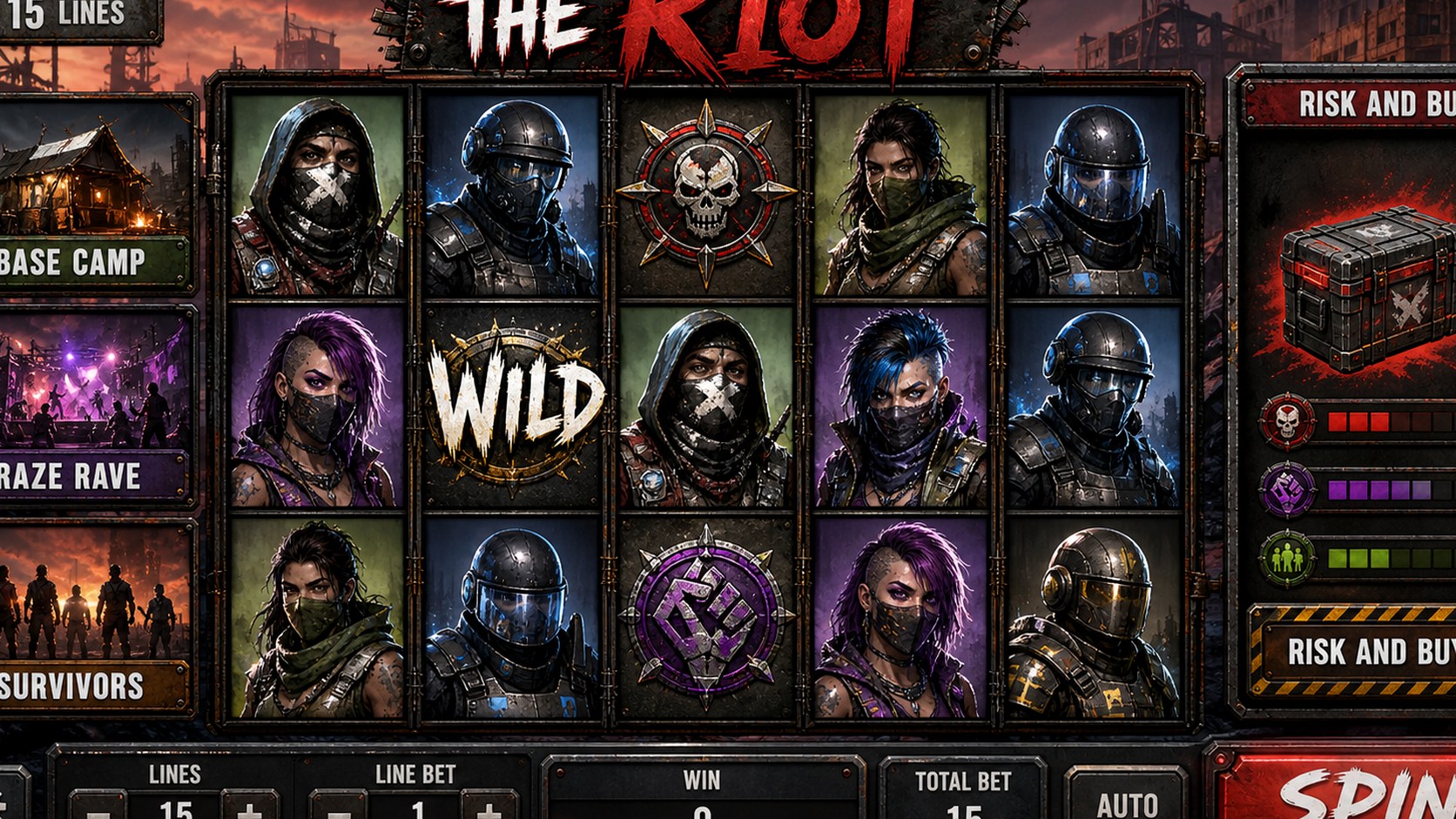
By Fairy Editorial - 24 Aug 2026
Columbus Deluxe Review: Ten Lines, Ten Free Spins and One Important Ship Rule
Columbus Deluxe
Columbus Deluxe Review: Ten Lines, Ten Free Spins and One Important Ship Rule

Columbus deluxe is easier to judge when its old-school presentation is separated from its accounting. The same rules identify Columbus as the ordinary Wild, exclude substitution for the Scatter and describe a separate red-or-black risk choice after an eligible win. The review therefore follows each debit, trigger, modifier and credited component instead of rating the scenery alone. Greentube catalogue material and regulated operator rules confirm a five-reel, three-row game with five to ten selectable paylines, a 95.02 percent return, three ship Scatters awarding ten free spins, ship symbols acting as additional Wilds during the feature, and retriggers adding another ten spins. Exact operator terms still belong to the deployed information panel. All three wide pictures are original editorial reconstructions based on published Greentube and operator rules. They are not Greentube screenshots, not historical illustrations and not records of a paid outcome. This article uses a strict evidence order: deployed help screen, studio catalogue, regulated operator rules and independent directory. Artwork can establish theme and symbol identity, but it cannot establish reel strips, probability, bonus frequency or the return setting selected by a particular operator. No paid wager was placed and no age-confirmation screen was bypassed. The available pages did not expose a complete lawful client for direct testing without eligibility confirmation, so there is no claimed personal hit rate or bonus sample. The analysis instead turns every published mechanism into a repeatable check for an eligible Philippine user. A useful test record includes the selected stake, active lines or ways, starting balance, round identifier, feature entry, each counter movement, component awards and final credit. It cannot forecast later rounds, but it can reveal a misunderstood rule or a settlement that requires operator support. Comparisons with newer fishing or exploration games also need care. Shared subjects do not create shared mathematics. A later release may alter its reel strips, volatility, bonus cost, retrigger rule or maximum credit while borrowing familiar characters and objects. The exact title and deployed help file define the product reviewed here; assumptions from a sequel or similarly named mobile cabinet are kept outside the calculation. The three landscape pictures are explanatory mobile compositions. Their balances, symbol positions and values are props. They must not be reused as proof that a feature triggered or that a stated amount was won.

Leaving the Harbor With the Rules Open

Columbus deluxe opens with navigation log and settlement ledger. The navigator Columbus Wild and Queen of Spain portraits, jeweled necklaces, sextants, card ranks and the Nina, Pinta and Santa Maria ships are not background ornaments; they form a visual hierarchy that tells the eye where to look before any rule has been read. The reel area sits inside that hierarchy, so symbols remain distinct from the scenery instead of dissolving into it.

That first reading matters on a phone. A slot may spend heavily on illustration and still fail if the stake, spin control or settled result is hard to locate. Here the strongest idea is not mere decoration. It is the way navy, sea green, parchment ivory, burgundy and antique gold separates the game board, framing art and controls into layers.

What Greentube and the Operator Publish

Greentube catalogue material and regulated operator rules confirm a five-reel, three-row game with five to ten selectable paylines, a 95.02 percent return, three ship Scatters awarding ten free spins, ship symbols acting as additional Wilds during the feature, and retriggers adding another ten spins. The same rules identify Columbus as the ordinary Wild, exclude substitution for the Scatter and describe a separate red-or-black risk choice after an eligible win.

This is the evidence boundary used here. The active client remains decisive for regional settings, stake units, optional controls and any later certified revision.

The 95.02 Percent Configuration

Greentube catalogue material lists 95.02 percent, with a regulated operator page printing 95.02279 percent for its deployment. The extra decimals describe the same published configuration more precisely; they do not predict a short session.

The game is commonly labelled low-to-medium or medium volatility. That classification describes distribution, not the chance that ships appear on the next spin.

A Classic Slot With Three Decisions

The word deluxe is the headline hook. It raises an obvious question: does it describe a multiplier, a progression, a visual motif or simply the scale of the story? Only the help screen can answer that. A number or power word in a logo is not automatically the highest cash ratio for a paid round.

Before treating the title as a promise, locate the line that defines it. Check the triggering symbols, the stage at which the value applies, any stake multiplier, the cap on simultaneous wins and any separate cash ceiling. If those conditions are absent, the name should remain a marketing label rather than a calculation.

Five Reels and Up to Ten Lines

The art follows the confirmed five-reel, three-row cabinet and ten-line maximum. The local client should confirm its selectable line range, bet-per-line options, return configuration and jurisdictional risk-game limit.

Geometry alone never settles a result. The help screen must also state the direction of wins, minimum matching count, active-line or ways unit, substitution exclusions and how simultaneous awards are combined.

Navigator, Queen, Necklace and Sextant

The theme naturally divides the reel set into character or object symbols, special icons and Ten through Ace card ranks. Queen of Spain portraits, jeweled necklaces, sextants, card ranks and the Nina, Pinta and Santa Maria ships carry more visual weight than the letters and numbers. That weight usually signals premium status, but the paytable may rank two similar objects very differently. Size and shine are clues, never final values.

Read every payout in the unit used by the game. Some tables show bet-per-line units; others use total stake. A five-of-a-kind figure can appear ten or twenty times larger if the unit is misunderstood. The cash meter after a test spin is useful, but the written help panel should settle the conversion.

The Card Ranks Carry Routine Returns

Ten through Ace card ranks occupy a large share of ordinary reel time in the editorial layout. They create visual breathing room around the premium art and make small combinations quick to recognize. Their role in the mathematical model may be larger than their small paytable values suggest because frequency and value are separate parts of return.

A low-symbol hit can light the grid while returning less than the amount staked. That is a paid result, not necessarily a profitable round. The correct comparison is final credit divided by the full spin cost. Animation length, coin count and sound volume do not change that ratio.

Tracing a Selected Payline

Large portraits and objects such as Queen of Spain portraits, jeweled necklaces, sextants, card ranks and the Nina, Pinta and Santa Maria ships can dominate the frame. The practical test is to follow one settled combination from its first symbol to its last without relying on flashing borders. Clear spacing between reels, consistent icon silhouettes and a visible route make the result easier to audit.

If several awards arrive together, open the win breakdown or history panel. One total may contain multiple lines, an anywhere payment and a modifier. Treating the largest symbol on screen as the sole cause can produce a false reading of the rule, especially when a substitute or multiplier is also present.

Columbus as the Base Wild

Columbus is the ordinary Wild and substitutes for every regular symbol but not the ship Scatter. His own paytable entry can begin with two matching symbols.

A Wild crossing several active paylines may substitute differently on each route. Only the highest valid combination on a given line is paid, while awards on separate lines are added.

Three Ships as Scatter

Three ship Scatters anywhere on the five-by-three screen produce a Scatter award and start ten free spins. The three vessels represent Nina, Pinta and Santa Maria but share the trigger role.

Another three-ship result inside free spins adds ten more actions. Scatter pays are independent of line shapes and are added to ordinary line returns.

The Ten-Free-Spin State

The defining feature change is simple: ship symbols become additional Wilds during free spins. They still carry their Scatter role, so one symbol family can help lines and retrigger the feature under separate rules.

Because the ships gain substitution power only in the feature, a base-game screenshot cannot be used to infer the same line completion behavior.

Base Rounds Before the Crossing

Many reviews rush past the paid reels and treat the bonus as the only meaningful part. That misses the money path. Base spins create nearly all turnover, settle small and medium awards, and decide how long a balance remains available. A rare feature cannot repair a stake level that is too high for the intended session.

Columbus deluxe needs ordinary results that are readable at a glance. A clean board lets the user distinguish a no-win, a partial return and a profit without waiting for a long count-up. That clarity is especially important when the surrounding Renaissance harbor at the edge of an Atlantic map is busy and the screen uses strong motion.

When Ships Become Extra Wilds

The feature starts with the same stake and line configuration used by the triggering round. Lines and bet per line cannot be changed until the free-spin sequence ends.

Ten initial actions can expand through ten-spin retriggers. Record the starting count and each added block rather than relying on the final celebration total.

Why There Is No Feature Multiplier to Invent

Published rules do not describe a general free-spin multiplier. The value change comes from three ship symbols acting as extra Wilds, which can create or lengthen line combinations.

Do not apply an invented x2 to the feature total. Each line should settle from its paytable entry, active line stake and valid Wild substitutions.

Putting Historic Paytable Values in Context

Clients often label results with tiers such as big, mega or super. Those labels are commonly based on the ratio between win and current stake. They do not prove that the result reached the mathematical ceiling. The count-up may also stop at a cash cap even when the theoretical symbol total is higher.

To calculate a genuine ratio, divide the credited result by the total stake removed for the paid round. Include free follow-up actions inside that same round unless the rules state otherwise. This method turns a loud presentation into a comparable number and avoids confusing coins on screen with peso value.

Picture One: Harbor Reconstruction

The first picture arranges the navigator, Queen, necklace, sextant, ranks and three ships on a parchment-toned five-by-three board. It is analytical art, not a duplicated studio frame.

The picture supports visual analysis only. It cannot certify reel strips, probability, a balance or a real trigger.

Picture Two: Lines, Wild and Ships

The second picture tightens around the Wild, Scatter ships and colored line indicators. It shows why active lines and substitution exclusions need separate checks.

The closer crop is useful for symbol roles and board spacing. A transaction history remains stronger evidence for every credited component.

Picture Three: Free Spins and Risk Choice

The third picture centres the ten-spin counter, transformed ship concept and red-or-black panel. It illustrates the rule sequence without claiming a feature or successful gamble.

The final image is a rule map rather than a result claim. Values and positions are props created for this article.

Captain ledger 19: Sound Design and Perceived Pace

navigation log and settlement ledger can be strengthened through layered music, reel-stop cues and short feature stingers. Sound is useful when it marks a trigger or completed calculation. It becomes less useful when every partial return receives the same fanfare as a clear profit.

Try several rounds with audio lowered. If the board still communicates outcome, the interface is doing its job. If the result becomes ambiguous without a voice line or long count-up, the visual feedback needs more attention. Audio should confirm settlement, not replace the numbers.

Captain ledger 20: Landscape Play and Thumb Reach

A horizontal phone gives the Renaissance harbor at the edge of an Atlantic map room on both sides of the reels. The central board remains large while settings, stake controls and spin can occupy the lower band. This arrangement works best when the largest button sits away from the minus and plus controls.

Before rapid play, rotate the device, enter full screen and check the total-stake field after one adjustment. Browser bars and system gestures can cover edge controls. A test spin at the minimum setting confirms that the hit boxes match the visible buttons and that no accidental Max Bet control sits beneath the thumb.

Captain ledger 21: Portrait Mode Is a Compromise

Portrait layout may scale the entire game down or reorganize controls beneath the grid. Tiny payline markers and condensed help text are the first casualties. The screen can remain playable, yet accurate rule reading becomes harder when the table requires repeated zooming or horizontal swipes.

Use portrait mode for quick navigation, not for the first rules check. Landscape is the better place to compare total stake, balance and win because all three can remain visible together. The relationship between those numbers matters more than keeping the device in one hand.

Captain ledger 22: Performance on Mid-Range Phones

The artwork uses multiple layers, large character cutouts and particle effects. On a mid-range handset, watch for delayed button response after a count-up, audio falling out of step with the reels or a stake change taking effect one round late. Those are interface problems, not signs of altered probability.

Close other heavy apps and use a stable connection during the first session. If the client reconnects, verify balance and the last completed round in history before spinning again. A frozen animation can recover after the server has already settled the result, so the account record takes priority over the last visible frame.

Captain ledger 23: Stake Controls Deserve More Attention Than the Mascot

Selectable paylines change both coverage and total debit, while the optional risk game can turn an already settled award into a new all-or-nothing decision. The most useful habit is to read total stake after every change and before the first rapid sequence. Bet per line, coin value and total bet may occupy separate fields, and altering one can multiply the final debit.

A planned session should be written in money, spins and time. Divide the session amount by the intended number of paid rounds to find a workable average stake. Free actions do not add a new debit unless the client states a purchase. This arithmetic is dull, but it controls exposure more reliably than any theme-based hunch.

Captain ledger 24: RTP Belongs to Turnover, Not a Short Run

Once the deployed RTP is known, interpret it as a long-run model ratio. If the help page lists 96 percent, theoretical cost is four units per hundred units of turnover. That sentence is an example of the calculation, not a claim that this version uses 96 percent.

Turnover equals total paid stake across accepted rounds. A hundred spins at one unit create one hundred units of turnover even if several free actions appear between them. A short session may finish far above or below the model ratio because random outcomes do not settle into a neat percentage on demand.

Captain ledger 25: Volatility Is About Distribution

Volatility describes how payout value is spread across outcomes. A higher band usually places more weight in less common large results; a lower band usually returns more of its value through smaller payments. The label does not state when a feature will arrive or how long a losing sequence can last.

Without an official band, infer nothing from navigation log and settlement ledger. A calm fruit village can use severe math, and a battlefield can use a mild distribution. After the label is found, use it to size stake and session length, not to forecast the next reel stop.

Captain ledger 26: Maximum Win Needs a Denominator

The Greentube catalogue shows Columbus paying 5,000 units for five on a line under its displayed paytable basis. That symbol value is not automatically a 5,000-times-total-bet maximum.

A full round can combine several lines, a Scatter award and multiple free spins. The operator also places a separate cash limit on the risk game, so every ceiling needs its own denominator.

Captain ledger 27: A Clean Demo Test in Thirty Paid Rounds

Use the minimum fixed stake and create one row for each paid round. Record starting balance, debit, base credit, feature credit, ending balance and any meter change. Keep free actions inside the row of the spin that triggered them. This format exposes the money flow without treating a tiny sample as statistical proof.

Thirty rounds are enough to learn button behavior, symbol settlement and feature messages. They are not enough to estimate RTP or trigger frequency. The purpose is mechanical literacy. Stop the test once each major control has been checked; more spins do not turn an informal sample into certification.

Captain ledger 28: How to Audit a Bonus From Start to Finish

Capture the trigger screen, starting counter, carried stake and opening multiplier. Then note each retrigger, held symbol, expanding reel or meter reset. At the end, compare the feature total with the history record and final balance. Every free action should trace back to one paid round.

If a purchase button exists, treat it as a separate bet mode. Record its price as the full stake for that round and read its RTP entry independently if the client lists one. A purchased feature may use the same animation while carrying a different cost structure.

Captain ledger 29: Common Misreads Around Columbus deluxe

The first misread is assuming that deluxe states the unconditional top award. The second is assigning premium status solely from symbol size. The third is treating a filling adjustable line selector, free-spin counter and optional red-or-black risk panel as proof that a feature is due. The fourth is calling every substitute a multiplier Wild without checking the rules.

The fifth is copying an RTP from an unrelated review. The sixth is counting free actions as fresh paid spins. The seventh is judging profit from the win banner instead of balance movement. Each mistake disappears when the player keeps the stake field, history panel and help page in the same audit.

Captain ledger 30: What Philippine Players Should Verify

A Philippine listing may use peso values, wallet credits or a converted coin display. Confirm the minimum and maximum total stake, not merely coin size. Check that the operator names Greentube as the studio, and compare the logo with the official key art before assuming that a similarly named title is the same product.

Also read local rules for feature purchases, autoplay, session reminders and cash limits. These controls belong to the operator build and jurisdiction. A screenshot from another market can explain layout, but it cannot establish the available stake range or certified return in a Philippine account.

Captain ledger 31: Who Gets the Most From This Theme

Readers who value older fixed-line Novomatic design and want the free-spin ship transformation explained without modern bonus clutter will find the presentation immediately legible. The theme also suits short review sessions because the visual hierarchy can be judged quickly. That does not make the mathematical profile suitable for every budget; the actual volatility and minimum total stake still control that decision.

Anyone who dislikes dense side art or loud event effects should test the sound and fast-play controls first. A strong theme can be a reason to open a demo, but it is not a reason to ignore the paytable. Interest in the artwork and comfort with the stake are separate choices.

Captain ledger 32: A Practical Decision Checklist

Before real play, confirm the exact title, studio, RTP, volatility, win method, Wild exceptions, Scatter route, feature trigger, multiplier scope, maximum-win denominator and cash cap. Then set a total session amount and a stopping time. If any critical rule remains hidden, keep the title in demo mode.

During play, watch balance rather than animation. After play, compare opening balance, deposits, withdrawals and ending balance with the history log. This checklist does not change random results. It changes how clearly the cost and settlement can be seen.

Captain ledger 33: Final Reading: Theme First, Math Before Money

Columbus deluxe is a compact classic whose depth sits in three accounting choices: how many lines are active, when three Scatters move the game into ten free spins, and if an eligible win should be collected instead of exposed to the risk game

Columbus deluxe earns attention through navigation log and settlement ledger and a tightly coordinated navy, sea green, parchment ivory, burgundy and antique gold palette. The next step is not a larger stake; it is the local information screen. Confirm the deployed math, test the controls at minimum value and treat every visual promise as a question that the rules must answer.

Captain ledger 34: Separating Hit Rate From Profit Rate

A hit is any result the rules count as a payment. Profit requires the credited amount to exceed the full stake for that paid round. A title can register frequent small hits while the balance declines. Without an official hit-frequency figure, the only safe statement is that the two rates are not interchangeable.

For a demo log, mark return ratios below 1x, exactly 1x and above 1x in separate columns. This reveals how many recorded wins were partial returns. It still does not predict future play, but it gives a much clearer account of the sample than a simple count of flashing win messages.

Captain ledger 35: Near Misses Are Animation, Not Progress

A bonus icon stopping just outside a payline or a premium symbol passing during reel motion can feel meaningful. Unless the written rule stores that event, it has no carry-over value. The next accepted round is not improved because the previous animation looked close.

The same caution applies to two trigger symbols when three are required. They may create suspense, yet their payment and stored effect depend entirely on the table. Record what was credited, then clear the image from the decision about the next stake.

Captain ledger 36: Fast Play Changes Exposure Speed

Fast play shortens animation; it does not normally change the random model. Its financial effect comes from time. More paid rounds can fit into the same minute, so the balance may move faster even though the stake per round stays fixed.

Measure pace before enabling it. Ten ordinary rounds on standard speed and ten on fast speed reveal the difference in turnover per minute. If the faster rate breaks the planned session limit, lower the stake or return to standard timing rather than relying on attention alone.

Captain ledger 37: Autoplay Needs Stop Conditions

Where autoplay is available, set a round count and use any loss, win or single-award limits shown by the client. Read those fields carefully because some are cash values while others are stake multipliers. An empty field may mean no automatic stop for that condition.

Remain present during automated rounds. Network reconnection, a feature choice or a changed balance can pause the sequence. Autoplay is a convenience control, not a budget system, and it does not make a long sample more likely to follow the theoretical return.

Captain ledger 38: Responsible Play in Plain Numbers

Set a sum that can be lost without affecting bills, savings or debt payments. Do not borrow to play, do not chase a prior loss and do not treat a rare large result as income. Time reminders and deposit limits are useful because strong game art can blur the length of a session.

If play stops feeling optional, close the client and use the operator exclusion or limit tools. The clearest review of any slot ends with the same fact: outcomes are random, the house keeps a mathematical margin over long turnover and no visual pattern creates a reliable edge.

By Fairy Editorial - 22 Aug 2026
Lucky Charms Review: A 6×6 Irish Grid Where Sticky Wilds Do the Heavy Work
Lucky Charms
Lucky Charms Review: A 6×6 Irish Grid Where Sticky Wilds Do the Heavy Work

Lucky Charms puts its premise on screen before the first paid action: The playable page was not available for a direct round, so those published specifications still need comparison with the Philippine operator build. The visible theme gives the review a place to start, but it cannot fill gaps in the rule sheet. Public listings identify Lucky Charms as a Venture Studios release dated 16 March 2026 with a 6 by 6 Scatter Pays grid, a 96.25 percent return, a 3.75 percent edge and a maximum award of 20000 times stake; sticky Wilds, free spins, multipliers and a purchase option are also named. Exact values from the active operator build take priority wherever public records are absent, contradictory or inaccessible. All three horizontal pictures are editorial reconstructions based on the published Irish theme and game structure. They avoid breakfast-cereal branding and do not present an invented screen as official Venture Studios footage.

This review uses a narrow evidence hierarchy. A first-party help panel in the deployed game would rank first, followed by a studio product page, then a public lobby record and finally a secondary catalogue. A picture may confirm visual identity, while a text listing may identify a grid or published return. Neither should be stretched into a claim about feature frequency, reel strips, random-number generation or the exact configuration used by a different operator. No paid wager was made for this article. The attempted public clients did not reach a usable game session, so there is no spin diary, hit-rate sample or personal balance result to report. The screen analysis instead asks what a Philippine player should verify once the local build opens: accepted stake, settlement unit, history entry, rule version, return setting, volatility label, maximum-award denominator and any separate cash limit. That is a more dependable review method than inventing a lucky session. The reconstructed pictures are designed to keep the discussion concrete on a phone-sized landscape canvas. Their controls, symbol positions, counters and values are props. They do not certify a pay route and must not be presented later as proof that a feature triggered. Where public material gives a specific layout, the artwork follows that broad structure; where the record is silent, the composition remains openly hypothetical. Every cash statement should still be checked against the accepted-round record after the screen has finished counting and before another action clears the display.

Opening the 6 by 6 Field

Lucky Charms opens with measured Irish treasure hunting. The leprechaun treasure keeper and clovers, horseshoes, emeralds, harps, rainbows, Celtic coins and pots of gold are not background ornaments; they form a visual hierarchy that tells the eye where to look before any rule has been read. The reel area sits inside that hierarchy, so symbols remain distinct from the scenery instead of dissolving into it.

That first reading matters on a phone. A slot may spend heavily on illustration and still fail if the stake, spin control or settled result is hard to locate. Here the strongest idea is not mere decoration. It is the way deep emerald, warm gold, clear sky blue and rainbow accents separates the game board, framing art and controls into layers.

What the Public Listings Agree On

Public listings identify Lucky Charms as a Venture Studios release dated 16 March 2026 with a 6 by 6 Scatter Pays grid, a 96.25 percent return, a 3.75 percent edge and a maximum award of 20000 times stake; sticky Wilds, free spins, multipliers and a purchase option are also named. The playable page was not available for a direct round, so those published specifications still need comparison with the Philippine operator build. This is the firm boundary of the evidence used here.

A catalogue image can establish identity and art direction. It cannot establish the exact RTP setting, volatility band, reel mathematics, bet limits or highest award in every operator build. Those facts belong to the information panel of the version actually loaded.

96.25 Percent and Its Correct Use

The published return is 96.25 percent, which corresponds to a 3.75 percent edge. The arithmetic is consistent, but the percentage applies to long theoretical turnover for the listed configuration, not to twelve free spins or one evening.

The same public record lists a 20000x ceiling. Check the Philippine client for a version identifier, any ante setting and a separate purchase-mode return before importing that figure into a cash calculation.

Charms Are Symbols, Not Predictions

The word Charms is the headline hook. It raises an obvious question: does it describe a multiplier, a progression, a visual motif or simply the scale of the story? Only the help screen can answer that. A number or power word in a logo is not automatically the highest cash ratio for a paid round.

Before treating the title as a promise, locate the line that defines it. Check the triggering symbols, the stage at which the value applies, any stake multiplier, the cap on simultaneous wins and any separate cash ceiling. If those conditions are absent, the name should remain a marketing label rather than a calculation.

Scatter Pays Across Thirty-Six Cells

The public layout is 6 by 6, giving thirty-six visible cells. Scatter Pays should count a required number of matching symbols anywhere on the grid rather than tracing a fixed payline. That makes symbol count more important than left-to-right shape.

The reconstruction follows the published 6 by 6 layout. Scatter Pays should count matching symbols across the board rather than along fixed lines, but the local manual must state the minimum count, excluded cells, Wild treatment and settlement order.

Building the Irish Symbol Ladder

The theme naturally divides the reel set into character or object symbols, special icons and small clover and coin symbols. clovers, horseshoes, emeralds, harps, rainbows, Celtic coins and pots of gold carry more visual weight than the letters and numbers. That weight usually signals premium status, but the paytable may rank two similar objects very differently. Size and shine are clues, never final values.

Read every payout in the unit used by the game. Some tables show bet-per-line units; others use total stake. A five-of-a-kind figure can appear ten or twenty times larger if the unit is misunderstood. The cash meter after a test spin is useful, but the written help panel should settle the conversion.

Small Clovers Still Matter

small clover and coin symbols occupy a large share of ordinary reel time in the editorial layout. They create visual breathing room around the premium art and make small combinations quick to recognize. Their role in the mathematical model may be larger than their small paytable values suggest because frequency and value are separate parts of return.

A low-symbol hit can light the grid while returning less than the amount staked. That is a paid result, not necessarily a profitable round. The correct comparison is final credit divided by the full spin cost. Animation length, coin count and sound volume do not change that ratio.

Counting Symbols Without Paylines

Large portraits and objects such as clovers, horseshoes, emeralds, harps, rainbows, Celtic coins and pots of gold can dominate the frame. The practical test is to follow one settled combination from its first symbol to its last without relying on flashing borders. Clear spacing between reels, consistent icon silhouettes and a visible route make the result easier to audit.

If several awards arrive together, open the win breakdown or history panel. One total may contain multiple lines, an anywhere payment and a modifier. Treating the largest symbol on screen as the sole cause can produce a false reading of the rule, especially when a substitute or multiplier is also present.

Sticky Wilds Need a Life Cycle

Sticky Wilds are most valuable when their lifetime is clear. The manual should state when they arrive, which symbols they replace, if they remain for every remaining free spin and when their multiplier changes.

A Wild fixed in one cell can join several different symbol counts over time. Each settlement should show which counted group used it and how conflicts are resolved when the same Wild could support more than one award.

Scatter Pays Is Not the Same as a Scatter Trigger

Scatter Pays describes a settlement system; a Scatter symbol describes a special icon. Those are separate ideas. The trigger into free spins may use designated symbols even though ordinary wins are also counted anywhere.

The help page must distinguish the minimum count for cash payments from the count needed for the feature. Do not assume every anywhere-paying symbol is also a trigger.

Reading the Free-Spin Field

The free-spin counter states remaining actions, while sticky Wild tiles state current feature conditions. Neither predicts a new trigger after the feature ends. Their value lasts only for the period defined by the rules.

Record when each Wild becomes sticky and when its badge changes. If a retrigger adds spins, note If existing Wilds remain and if new ones share the same multiplier ladder.

Base Rounds Before Persistence

Many reviews rush past the paid reels and treat the bonus as the only meaningful part. That misses the money path. Base spins create nearly all turnover, settle small and medium awards, and decide how long a balance remains available. A rare feature cannot repair a stake level that is too high for the intended session.

Lucky Charms needs ordinary results that are readable at a glance. A clean board lets the user distinguish a no-win, a partial return and a profit without waiting for a long count-up. That clarity is especially important when the surrounding Irish valley beneath a rainbow is busy and the screen uses strong motion.

How Sticky Multipliers Change the Feature

Free spins should turn persistence into the central mechanic. A Wild fixed early can participate in later Scatter Pays counts, and a multiplier can raise the value attached to those later settlements.

The purchase option begins with a separate debit. Compare its price, starting spin count, starting Wild state and listed return against a natural trigger. Matching artwork does not guarantee matching economics.

Stacking, Adding or Multiplying

If several sticky Wilds join one counted group, the rules must say if their badges add, multiply or use only the highest. On a 6 by 6 grid that distinction can create a large difference.

Check settlement order as well. The game may total base symbol value first and then apply one combined multiplier, or calculate separate components around each Wild. History should expose the path.

Putting 20000x in Context

Clients often label results with tiers such as big, mega or super. Those labels are commonly based on the ratio between win and current stake. They do not prove that the result reached the mathematical ceiling. The count-up may also stop at a cash cap even when the theoretical symbol total is higher.

To calculate a genuine ratio, divide the credited result by the total stake removed for the paid round. Include free follow-up actions inside that same round unless the rules state otherwise. This method turns a loud presentation into a comparable number and avoids confusing coins on screen with peso value.

Picture One: Irish Grid Reconstruction

The first picture establishes the 6 by 6 field, rainbow valley and original leprechaun guide. It is newly created review art, not a Venture Studios capture or a cereal-brand imitation.

The picture belongs to the visual review only. It must never be used as a substitute for a paytable, probability statement or operator-specific stake range.

Picture Two: Counting the 6 by 6 Board

The second picture brings the symbol matrix forward so clovers, horseshoes, emeralds, harps, rainbows and pots can be compared without relying on paylines.

Its job is to make phone layout, symbol hierarchy and control placement easier to discuss. The written rules remain the authority for every cash calculation.

Picture Three: Sticky Wild Study

The third picture centers the sticky Wild badges and free-spin counter. The visible 2x, 3x and 5x labels are explanatory props and do not certify the actual multiplier set.

A live history panel should show more than any promotional still: original stake, component awards, modifiers and final credit. That record is the correct place to audit settlement.

Clover ledger 19: Sound Design and Perceived Pace

measured Irish treasure hunting can be strengthened through layered music, reel-stop cues and short feature stingers. Sound is useful when it marks a trigger or completed calculation. It becomes less useful when every partial return receives the same fanfare as a clear profit.

Try several rounds with audio lowered. If the board still communicates outcome, the interface is doing its job. If the result becomes ambiguous without a voice line or long count-up, the visual feedback needs more attention. Audio should confirm settlement, not replace the numbers.

Clover ledger 20: Landscape Play and Thumb Reach

A horizontal phone gives the Irish valley beneath a rainbow room on both sides of the reels. The central board remains large while settings, stake controls and spin can occupy the lower band. This arrangement works best when the largest button sits away from the minus and plus controls.

Before rapid play, rotate the device, enter full screen and check the total-stake field after one adjustment. Browser bars and system gestures can cover edge controls. A test spin at the minimum setting confirms that the hit boxes match the visible buttons and that no accidental Max Bet control sits beneath the thumb.

Clover ledger 21: Portrait Mode Is a Compromise

Portrait layout may scale the entire game down or reorganize controls beneath the grid. Tiny payline markers and condensed help text are the first casualties. The screen can remain playable, yet accurate rule reading becomes harder when the table requires repeated zooming or horizontal swipes.

Use portrait mode for quick navigation, not for the first rules check. Landscape is the better place to compare total stake, balance and win because all three can remain visible together. The relationship between those numbers matters more than keeping the device in one hand.

Clover ledger 22: Performance on Mid-Range Phones

The artwork uses multiple layers, large character cutouts and particle effects. On a mid-range handset, watch for delayed button response after a count-up, audio falling out of step with the reels or a stake change taking effect one round late. Those are interface problems, not signs of altered probability.

Close other heavy apps and use a stable connection during the first session. If the client reconnects, verify balance and the last completed round in history before spinning again. A frozen animation can recover after the server has already settled the result, so the account record takes priority over the last visible frame.

Clover ledger 23: Stake Controls Deserve More Attention Than the Mascot

Persistent Wild tiles create visible progress inside a feature, but that progress belongs only to the current rule state and says nothing about the timing of the next trigger. The most useful habit is to read total stake after every change and before the first rapid sequence. Bet per line, coin value and total bet may occupy separate fields, and altering one can multiply the final debit.

A planned session should be written in money, spins and time. Divide the session amount by the intended number of paid rounds to find a workable average stake. Free actions do not add a new debit unless the client states a purchase. This arithmetic is dull, but it controls exposure more reliably than any theme-based hunch.

Clover ledger 24: RTP Belongs to Turnover, Not a Short Run

Once the deployed RTP is known, interpret it as a long-run model ratio. If the help page lists 96 percent, theoretical cost is four units per hundred units of turnover. That sentence is an example of the calculation, not a claim that this version uses 96 percent.

Turnover equals total paid stake across accepted rounds. A hundred spins at one unit create one hundred units of turnover even if several free actions appear between them. A short session may finish far above or below the model ratio because random outcomes do not settle into a neat percentage on demand.

Clover ledger 25: Volatility Is About Distribution

Volatility describes how payout value is spread across outcomes. A higher band usually places more weight in less common large results; a lower band usually returns more of its value through smaller payments. The label does not state when a feature will arrive or how long a losing sequence can last.

Without an official band, infer nothing from measured Irish treasure hunting. A calm fruit village can use severe math, and a battlefield can use a mild distribution. After the label is found, use it to size stake and session length, not to forecast the next reel stop.

Clover ledger 26: Maximum Win Needs a Denominator

The public maximum is 20000 times stake. Confirm that the denominator is total stake for the triggering paid round and check if a fixed cash limit can stop credit below the theoretical symbol total.

The cap does not reveal hit rate, free-spin frequency or typical feature value. It is the far boundary of the rule set, not a target around which a session should be planned.

Clover ledger 27: A Clean Demo Test in Thirty Paid Rounds

Use the minimum fixed stake and create one row for each paid round. Record starting balance, debit, base credit, feature credit, ending balance and any meter change. Keep free actions inside the row of the spin that triggered them. This format exposes the money flow without treating a tiny sample as statistical proof.

Thirty rounds are enough to learn button behavior, symbol settlement and feature messages. They are not enough to estimate RTP or trigger frequency. The purpose is mechanical literacy. Stop the test once each major control has been checked; more spins do not turn an informal sample into certification.

Clover ledger 28: How to Audit a Bonus From Start to Finish

Capture the trigger screen, starting counter, carried stake and opening multiplier. Then note each retrigger, held symbol, expanding reel or meter reset. At the end, compare the feature total with the history record and final balance. Every free action should trace back to one paid round.

If a purchase button exists, treat it as a separate bet mode. Record its price as the full stake for that round and read its RTP entry independently if the client lists one. A purchased feature may use the same animation while carrying a different cost structure.

Clover ledger 29: Common Misreads Around Lucky Charms

The first misread is assuming that Charms states the unconditional top award. The second is assigning premium status solely from symbol size. The third is treating a filling free-spin counter and sticky-Wild field as proof that a feature is due. The fourth is calling every substitute a multiplier Wild without checking the rules.

The fifth is copying an RTP from an unrelated review. The sixth is counting free actions as fresh paid spins. The seventh is judging profit from the win banner instead of balance movement. Each mistake disappears when the player keeps the stake field, history panel and help page in the same audit.

Clover ledger 30: What Philippine Players Should Verify

A Philippine listing may use peso values, wallet credits or a converted coin display. Confirm the minimum and maximum total stake, not merely coin size. Check that the operator names Venture Studios as the studio, and compare the logo with the official key art before assuming that a similarly named title is the same product.

Also read local rules for feature purchases, autoplay, session reminders and cash limits. These controls belong to the operator build and jurisdiction. A screenshot from another market can explain layout, but it cannot establish the available stake range or certified return in a Philippine account.

Clover ledger 31: Who Gets the Most From This Theme

Readers who like large square grids, anywhere symbol counts and free-spin states in which sticky multipliers reshape later rounds will find the presentation immediately legible. The theme also suits short review sessions because the visual hierarchy can be judged quickly. That does not make the mathematical profile suitable for every budget; the actual volatility and minimum total stake still control that decision.

Anyone who dislikes dense side art or loud event effects should test the sound and fast-play controls first. A strong theme can be a reason to open a demo, but it is not a reason to ignore the paytable. Interest in the artwork and comfort with the stake are separate choices.

Clover ledger 32: A Practical Decision Checklist

Before real play, confirm the exact title, studio, RTP, volatility, win method, Wild exceptions, Scatter route, feature trigger, multiplier scope, maximum-win denominator and cash cap. Then set a total session amount and a stopping time. If any critical rule remains hidden, keep the title in demo mode.

During play, watch balance rather than animation. After play, compare opening balance, deposits, withdrawals and ending balance with the history log. This checklist does not change random results. It changes how clearly the cost and settlement can be seen.

Clover ledger 33: Final Reading: Theme First, Math Before Money

Lucky Charms has a disciplined public specification: 6 by 6 Scatter Pays, 96.25 percent return, 20000x cap and sticky multiplier Wilds. Its main test is clarity, because a crowded square grid must still show which symbols were counted and which multiplier touched each award

Lucky Charms earns attention through measured Irish treasure hunting and a tightly coordinated deep emerald, warm gold, clear sky blue and rainbow accents palette. The next step is not a larger stake; it is the local information screen. Confirm the deployed math, test the controls at minimum value and treat every visual promise as a question that the rules must answer.

Clover ledger 34: Separating Hit Rate From Profit Rate

A hit is any result the rules count as a payment. Profit requires the credited amount to exceed the full stake for that paid round. A title can register frequent small hits while the balance declines. Without an official hit-frequency figure, the only safe statement is that the two rates are not interchangeable.

For a demo log, mark return ratios below 1x, exactly 1x and above 1x in separate columns. This reveals how many recorded wins were partial returns. It still does not predict future play, but it gives a much clearer account of the sample than a simple count of flashing win messages.

Clover ledger 35: Near Misses Are Animation, Not Progress

A bonus icon stopping just outside a payline or a premium symbol passing during reel motion can feel meaningful. Unless the written rule stores that event, it has no carry-over value. The next accepted round is not improved because the previous animation looked close.

The same caution applies to two trigger symbols when three are required. They may create suspense, yet their payment and stored effect depend entirely on the table. Record what was credited, then clear the image from the decision about the next stake.

Clover ledger 36: Fast Play Changes Exposure Speed

Fast play shortens animation; it does not normally change the random model. Its financial effect comes from time. More paid rounds can fit into the same minute, so the balance may move faster even though the stake per round stays fixed.

Measure pace before enabling it. Ten ordinary rounds on standard speed and ten on fast speed reveal the difference in turnover per minute. If the faster rate breaks the planned session limit, lower the stake or return to standard timing rather than relying on attention alone.

Clover ledger 37: Autoplay Needs Stop Conditions

Where autoplay is available, set a round count and use any loss, win or single-award limits shown by the client. Read those fields carefully because some are cash values while others are stake multipliers. An empty field may mean no automatic stop for that condition.

Remain present during automated rounds. Network reconnection, a feature choice or a changed balance can pause the sequence. Autoplay is a convenience control, not a budget system, and it does not make a long sample more likely to follow the theoretical return.

Clover ledger 38: Responsible Play in Plain Numbers

Set a sum that can be lost without affecting bills, savings or debt payments. Do not borrow to play, do not chase a prior loss and do not treat a rare large result as income. Time reminders and deposit limits are useful because strong game art can blur the length of a session.

If play stops feeling optional, close the client and use the operator exclusion or limit tools. The clearest review of any slot ends with the same fact: outcomes are random, the house keeps a mathematical margin over long turnover and no visual pattern creates a reliable edge.
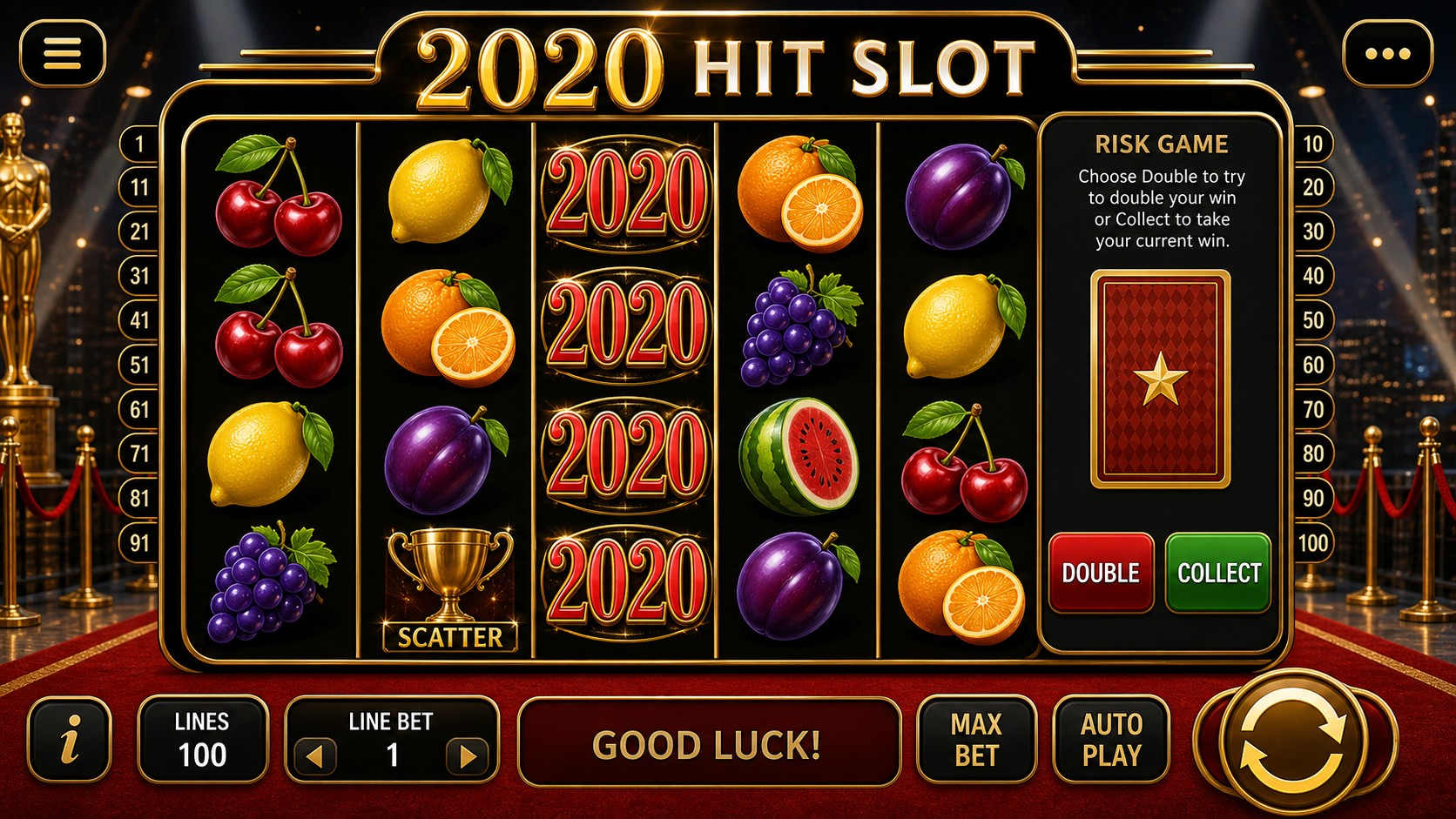
By Fairy Editorial - 21 Aug 2026
Gold Party Review: Four Respin Boards Competing for the Same Coins
Gold Party
Gold Party Review: Four Respin Boards Competing for the Same Coins

Gold Party puts its central idea on screen before the first paid action. The protected demo remained behind the studio age layer, so the article does not claim a personally triggered respin. That gives the review a clear starting point without turning inaccessible details into guesses. Pragmatic Play publishes Gold Party in its catalogue and names Wild paylines, a Money Respin Feature, a Multiplier symbol and an Extra Spin symbol; its page lists a 96.50 percent return, while public directories attribute the design to Wild Streak Gaming and describe a 5 by 3, 25-line high-volatility model. The operator help panel still takes priority for regional stake ranges, return variants and cash limits. The three horizontal pictures are editorial reconstructions based on published descriptions. They are not Wild Streak Gaming or Pragmatic Play screenshots, and the four boards do not record a live feature. This article follows a strict evidence order. A live help panel in the deployed client would rank first, followed by a studio product page, an operator listing and then a secondary directory. Artwork can establish identity and theme; it cannot certify reel strips, probabilities, feature frequency or a regional return setting. Any figure lacking a visible first-party rule is identified as secondary rather than repeated as fact. No paid wager was placed. The available demo components remained behind age or security layers, so there is no personal spin sample, balance result or claimed hit rate. The review instead maps each published mechanism to a check that can be completed once the Philippine build opens: stake debit, settlement unit, history entry, return configuration, volatility label, maximum-award denominator and cash ceiling. The reconstructed pictures keep the analysis concrete on a landscape phone canvas. Their controls, symbols, counters and values are props. They should never be reused as proof that a bonus triggered or a particular award occurred. Where the studio publishes a grid, the art follows its broad shape; where the record is silent, the layout is openly hypothetical.

Arriving Before the Music Starts

Gold Party opens with busy Irish pub accounting. The red-haired party host and clovers, horseshoes, harps, pipes, lucky sevens, pots of gold, Money coins and Wild emblems are not background ornaments; they form a visual hierarchy that tells the eye where to look before any rule has been read. The reel area sits inside that hierarchy, so symbols remain distinct from the scenery instead of dissolving into it.

That first reading matters on a phone. A slot may spend heavily on illustration and still fail if the stake, spin control or settled result is hard to locate. Here the strongest idea is not mere decoration. It is the way pub emerald, warm amber, moonlit blue and polished gold separates the game board, framing art and controls into layers.

What the Public Catalogue States

Pragmatic Play publishes Gold Party in its catalogue and names Wild paylines, a Money Respin Feature, a Multiplier symbol and an Extra Spin symbol; its page lists a 96.50 percent return, while public directories attribute the design to Wild Streak Gaming and describe a 5 by 3, 25-line high-volatility model. The protected demo remained behind the studio age layer, so the article does not claim a personally triggered respin. This is the firm boundary of the evidence used here.

A catalogue image can establish identity and art direction. It cannot establish the exact RTP setting, volatility band, reel mathematics, bet limits or highest award in every operator build. Those facts belong to the information panel of the version actually loaded.

Reading the Listed 96.50 Percent

The studio catalogue shows 96.50 percent. Verify the operator configuration because return settings can vary while the game name and Irish art remain unchanged.

Public directories label volatility high. Four respin boards can produce long dry intervals and irregular feature totals, but the label does not estimate the timing of the next Money trigger.

Party Is Presentation, Not Probability

The word Party is the headline hook. It raises an obvious question: does it describe a multiplier, a progression, a visual motif or simply the scale of the story? Only the help screen can answer that. A number or power word in a logo is not automatically the highest cash ratio for a paid round.

Before treating the title as a promise, locate the line that defines it. Check the triggering symbols, the stage at which the value applies, any stake multiplier, the cap on simultaneous wins and any separate cash ceiling. If those conditions are absent, the name should remain a marketing label rather than a calculation.

The Published Five-by-Three Cabinet

Secondary specifications describe five reels, three rows and twenty-five fixed paylines. The local paytable should display all routes and the total-stake unit attached to them.

The base reconstruction follows the widely published 5 by 3 and 25-line description. The active information panel should still confirm total-stake units, line direction and any configuration changes.

Clovers, Harps and Money Coins

The theme naturally divides the reel set into character or object symbols, special icons and classic lucky objects and card-like symbols. clovers, horseshoes, harps, pipes, lucky sevens, pots of gold, Money coins and Wild emblems carry more visual weight than the letters and numbers. That weight usually signals premium status, but the paytable may rank two similar objects very differently. Size and shine are clues, never final values.

Read every payout in the unit used by the game. Some tables show bet-per-line units; others use total stake. A five-of-a-kind figure can appear ten or twenty times larger if the unit is misunderstood. The cash meter after a test spin is useful, but the written help panel should settle the conversion.

Quiet Symbols Beneath the Gold

classic lucky objects and card-like symbols occupy a large share of ordinary reel time in the editorial layout. They create visual breathing room around the premium art and make small combinations quick to recognize. Their role in the mathematical model may be larger than their small paytable values suggest because frequency and value are separate parts of return.

A low-symbol hit can light the grid while returning less than the amount staked. That is a paid result, not necessarily a profitable round. The correct comparison is final credit divided by the full spin cost. Animation length, coin count and sound volume do not change that ratio.

Following One of Twenty-Five Lines

Large portraits and objects such as clovers, horseshoes, harps, pipes, lucky sevens, pots of gold, Money coins and Wild emblems can dominate the frame. The practical test is to follow one settled combination from its first symbol to its last without relying on flashing borders. Clear spacing between reels, consistent icon silhouettes and a visible route make the result easier to audit.

If several awards arrive together, open the win breakdown or history panel. One total may contain multiple lines, an anywhere payment and a modifier. Treating the largest symbol on screen as the sole cause can produce a false reading of the rule, especially when a substitute or multiplier is also present.

Wilds in the Base Grid

A Wild description is incomplete until three points are known: which symbols it copies, where it can land and if it carries its own value or multiplier. It may exclude Scatters, bonus icons or jackpots. Some Wilds expand or stay in place; others do nothing beyond substitution. The artwork cannot settle those exceptions.

When a Wild appears, compare the marked winning path with the natural symbols around it. Then check if the game pays the best valid combination or adds a separate Wild award. This small audit prevents a common error in which every decorated emblem is assumed to copy everything on the board.

What Starts the Money Respin

A Scatter generally counts across specified reels or anywhere on the grid, but the required count and eligible positions vary. Three matching icons might start a feature in one version and merely pay in another. Some titles require the first, third and fifth reels; others accept any three positions.

Record the full trigger screen before naming the rule. Count the symbols, note their reels and wait for the award message. If the next screen changes mode, check the starting counter and carried stake. One observed trigger explains a route; it does not estimate how often that route will happen.

Four Boards, Four Separate Ledgers

The four Money Respin boards must be read separately. A coin can belong to one board, and each board may have its own fixed award, held positions and remaining-action counter.

Take one screenshot at feature entry and one after every Extra Spin. A combined celebration at the end should reconcile with the sum of all four ledgers.

Base Spins Before the Party Breaks Open

Many reviews rush past the paid reels and treat the bonus as the only meaningful part. That misses the money path. Base spins create nearly all turnover, settle small and medium awards, and decide how long a balance remains available. A rare feature cannot repair a stake level that is too high for the intended session.

Gold Party needs ordinary results that are readable at a glance. A clean board lets the user distinguish a no-win, a partial return and a profit without waiting for a long count-up. That clarity is especially important when the surrounding moonlit Irish hillside pub is busy and the screen uses strong motion.

Multiplier and Extra Spin Coins

Money Respins hold value-bearing coins while empty positions respin. The public catalogue also names a Multiplier symbol and an Extra Spin symbol, which change value and duration rather than merely adding decoration.

The manual should state which matrices receive each modifier. A multiplier on one board should not be assumed to raise coins held on the other three.

Attaching Each Modifier to Its Board

A Multiplier coin needs a target: one adjacent coin, the board total or the full four-board feature. Its color and location can suggest scope, but the rule sentence decides.

Extra Spin is a duration modifier, not a cash multiplier. Record it as an added action before calculating the final feature ratio.

The 5000x Directory Claim Needs Local Terms

Clients often label results with tiers such as big, mega or super. Those labels are commonly based on the ratio between win and current stake. They do not prove that the result reached the mathematical ceiling. The count-up may also stop at a cash cap even when the theoretical symbol total is higher.

To calculate a genuine ratio, divide the credited result by the total stake removed for the paid round. Include free follow-up actions inside that same round unless the rules state otherwise. This method turns a loud presentation into a comparable number and avoids confusing coins on screen with peso value.

Picture One: Irish Party Reconstruction

The first picture places the five-by-three base board above four compact respin matrices. Its original host and pub setting are review art, while the named feature components follow the public catalogue.

The picture belongs to the visual review only. It must never be used as a substitute for a paytable, probability statement or operator-specific stake range.

Picture Two: Base Board Close-Up

The second picture moves closer to the base grid and fixed-line spacing. Clover, harp, pipe, seven, pot and Wild positions do not certify symbol values.

Its job is to make phone layout, symbol hierarchy and control placement easier to discuss. The written rules remain the authority for every cash calculation.

Picture Three: Four Respin Matrices

The third picture enlarges the Mini, Minor, Major and Grand-style boards with Multiplier and Extra Spin coins. It is a settlement diagram rather than a documented jackpot event.

A live history panel should show more than any promotional still: original stake, component awards, modifiers and final credit. That record is the correct place to audit settlement.

Party account 19: Sound Design and Perceived Pace

busy Irish pub accounting can be strengthened through layered music, reel-stop cues and short feature stingers. Sound is useful when it marks a trigger or completed calculation. It becomes less useful when every partial return receives the same fanfare as a clear profit.

Try several rounds with audio lowered. If the board still communicates outcome, the interface is doing its job. If the result becomes ambiguous without a voice line or long count-up, the visual feedback needs more attention. Audio should confirm settlement, not replace the numbers.

Party account 20: Landscape Play and Thumb Reach

A horizontal phone gives the moonlit Irish hillside pub room on both sides of the reels. The central board remains large while settings, stake controls and spin can occupy the lower band. This arrangement works best when the largest button sits away from the minus and plus controls.

Before rapid play, rotate the device, enter full screen and check the total-stake field after one adjustment. Browser bars and system gestures can cover edge controls. A test spin at the minimum setting confirms that the hit boxes match the visible buttons and that no accidental Max Bet control sits beneath the thumb.

Party account 21: Portrait Mode Is a Compromise

Portrait layout may scale the entire game down or reorganize controls beneath the grid. Tiny payline markers and condensed help text are the first casualties. The screen can remain playable, yet accurate rule reading becomes harder when the table requires repeated zooming or horizontal swipes.

Use portrait mode for quick navigation, not for the first rules check. Landscape is the better place to compare total stake, balance and win because all three can remain visible together. The relationship between those numbers matters more than keeping the device in one hand.

Party account 22: Performance on Mid-Range Phones

The artwork uses multiple layers, large character cutouts and particle effects. On a mid-range handset, watch for delayed button response after a count-up, audio falling out of step with the reels or a stake change taking effect one round late. Those are interface problems, not signs of altered probability.

Close other heavy apps and use a stable connection during the first session. If the client reconnects, verify balance and the last completed round in history before spinning again. A frozen animation can recover after the server has already settled the result, so the account record takes priority over the last visible frame.

Party account 23: Stake Controls Deserve More Attention Than the Mascot

Four simultaneous boards create more motion and more apparent progress, making it easy to lose track of which held coin contributed to the final total. The most useful habit is to read total stake after every change and before the first rapid sequence. Bet per line, coin value and total bet may occupy separate fields, and altering one can multiply the final debit.

A planned session should be written in money, spins and time. Divide the session amount by the intended number of paid rounds to find a workable average stake. Free actions do not add a new debit unless the client states a purchase. This arithmetic is dull, but it controls exposure more reliably than any theme-based hunch.

Party account 24: RTP Belongs to Turnover, Not a Short Run

Once the deployed RTP is known, interpret it as a long-run model ratio. If the help page lists 96 percent, theoretical cost is four units per hundred units of turnover. That sentence is an example of the calculation, not a claim that this version uses 96 percent.

Turnover equals total paid stake across accepted rounds. A hundred spins at one unit create one hundred units of turnover even if several free actions appear between them. A short session may finish far above or below the model ratio because random outcomes do not settle into a neat percentage on demand.

Party account 25: Volatility Is About Distribution

Volatility describes how payout value is spread across outcomes. A higher band usually places more weight in less common large results; a lower band usually returns more of its value through smaller payments. The label does not state when a feature will arrive or how long a losing sequence can last.

Without an official band, infer nothing from busy Irish pub accounting. A calm fruit village can use severe math, and a battlefield can use a mild distribution. After the label is found, use it to size stake and session length, not to forecast the next reel stop.

Party account 26: Maximum Win Needs a Denominator

Public directories list a 5000x maximum. Confirm If that ratio includes fixed board awards and all four Money Respin totals, and check for a lower cash ceiling.

A fixed top award shown above a board may be one route into the on balance cap. It should not be added twice when history already includes it in the feature total.

Party account 27: A Clean Demo Test in Thirty Paid Rounds

Use the minimum fixed stake and create one row for each paid round. Record starting balance, debit, base credit, feature credit, ending balance and any meter change. Keep free actions inside the row of the spin that triggered them. This format exposes the money flow without treating a tiny sample as statistical proof.

Thirty rounds are enough to learn button behavior, symbol settlement and feature messages. They are not enough to estimate RTP or trigger frequency. The purpose is mechanical literacy. Stop the test once each major control has been checked; more spins do not turn an informal sample into certification.

Party account 28: How to Audit a Bonus From Start to Finish

Capture the trigger screen, starting counter, carried stake and opening multiplier. Then note each retrigger, held symbol, expanding reel or meter reset. At the end, compare the feature total with the history record and final balance. Every free action should trace back to one paid round.

If a purchase button exists, treat it as a separate bet mode. Record its price as the full stake for that round and read its RTP entry independently if the client lists one. A purchased feature may use the same animation while carrying a different cost structure.

Party account 29: Common Misreads Around Gold Party

The first misread is assuming that Party states the unconditional top award. The second is assigning premium status solely from symbol size. The third is treating a filling four Money Respin boards as proof that a feature is due. The fourth is calling every substitute a multiplier Wild without checking the rules.

The fifth is copying an RTP from an unrelated review. The sixth is counting free actions as fresh paid spins. The seventh is judging profit from the win banner instead of balance movement. Each mistake disappears when the player keeps the stake field, history panel and help page in the same audit.

Party account 30: What Philippine Players Should Verify

A Philippine listing may use peso values, wallet credits or a converted coin display. Confirm the minimum and maximum total stake, not merely coin size. Check that the operator names Wild Streak Gaming as the studio, and compare the logo with the official key art before assuming that a similarly named title is the same product.

Also read local rules for feature purchases, autoplay, session reminders and cash limits. These controls belong to the operator build and jurisdiction. A screenshot from another market can explain layout, but it cannot establish the available stake range or certified return in a Philippine account.

Party account 31: Who Gets the Most From This Theme

Readers who enjoy Irish lucky-symbol slots but want the main bonus separated into four clearly audited hold-and-respin boards will find the presentation immediately legible. The theme also suits short review sessions because the visual hierarchy can be judged quickly. That does not make the mathematical profile suitable for every budget; the actual volatility and minimum total stake still control that decision.

Anyone who dislikes dense side art or loud event effects should test the sound and fast-play controls first. A strong theme can be a reason to open a demo, but it is not a reason to ignore the paytable. Interest in the artwork and comfort with the stake are separate choices.

Party account 32: A Practical Decision Checklist

Before real play, confirm the exact title, studio, RTP, volatility, win method, Wild exceptions, Scatter route, feature trigger, multiplier scope, maximum-win denominator and cash cap. Then set a total session amount and a stopping time. If any critical rule remains hidden, keep the title in demo mode.

During play, watch balance rather than animation. After play, compare opening balance, deposits, withdrawals and ending balance with the history log. This checklist does not change random results. It changes how clearly the cost and settlement can be seen.

Party account 33: Final Reading: Theme First, Math Before Money

Gold Party is less about its familiar clovers than about the four-board Money Respin. The design succeeds only if each board, held coin, multiplier, extra action and final sum can be traced without relying on the celebration screen

Gold Party earns attention through busy Irish pub accounting and a tightly coordinated pub emerald, warm amber, moonlit blue and polished gold palette. The next step is not a larger stake; it is the local information screen. Confirm the deployed math, test the controls at minimum value and treat every visual promise as a question that the rules must answer.

Party account 34: Separating Hit Rate From Profit Rate

A hit is any result the rules count as a payment. Profit requires the credited amount to exceed the full stake for that paid round. A title can register frequent small hits while the balance declines. Without an official hit-frequency figure, the only safe statement is that the two rates are not interchangeable.

For a demo log, mark return ratios below 1x, exactly 1x and above 1x in separate columns. This reveals how many recorded wins were partial returns. It still does not predict future play, but it gives a much clearer account of the sample than a simple count of flashing win messages.

Party account 35: Near Misses Are Animation, Not Progress

A bonus icon stopping just outside a payline or a premium symbol passing during reel motion can feel meaningful. Unless the written rule stores that event, it has no carry-over value. The next accepted round is not improved because the previous animation looked close.

The same caution applies to two trigger symbols when three are required. They may create suspense, yet their payment and stored effect depend entirely on the table. Record what was credited, then clear the image from the decision about the next stake.

Party account 36: Fast Play Changes Exposure Speed

Fast play shortens animation; it does not normally change the random model. Its financial effect comes from time. More paid rounds can fit into the same minute, so the balance may move faster even though the stake per round stays fixed.

Measure pace before enabling it. Ten ordinary rounds on standard speed and ten on fast speed reveal the difference in turnover per minute. If the faster rate breaks the planned session limit, lower the stake or return to standard timing rather than relying on attention alone.

Party account 37: Autoplay Needs Stop Conditions

Where autoplay is available, set a round count and use any loss, win or single-award limits shown by the client. Read those fields carefully because some are cash values while others are stake multipliers. An empty field may mean no automatic stop for that condition.

Remain present during automated rounds. Network reconnection, a feature choice or a changed balance can pause the sequence. Autoplay is a convenience control, not a budget system, and it does not make a long sample more likely to follow the theoretical return.

Party account 38: Responsible Play in Plain Numbers

Set a sum that can be lost without affecting bills, savings or debt payments. Do not borrow to play, do not chase a prior loss and do not treat a rare large result as income. Time reminders and deposit limits are useful because strong game art can blur the length of a session.

If play stops feeling optional, close the client and use the operator exclusion or limit tools. The clearest review of any slot ends with the same fact: outcomes are random, the house keeps a mathematical margin over long turnover and no visual pattern creates a reliable edge.
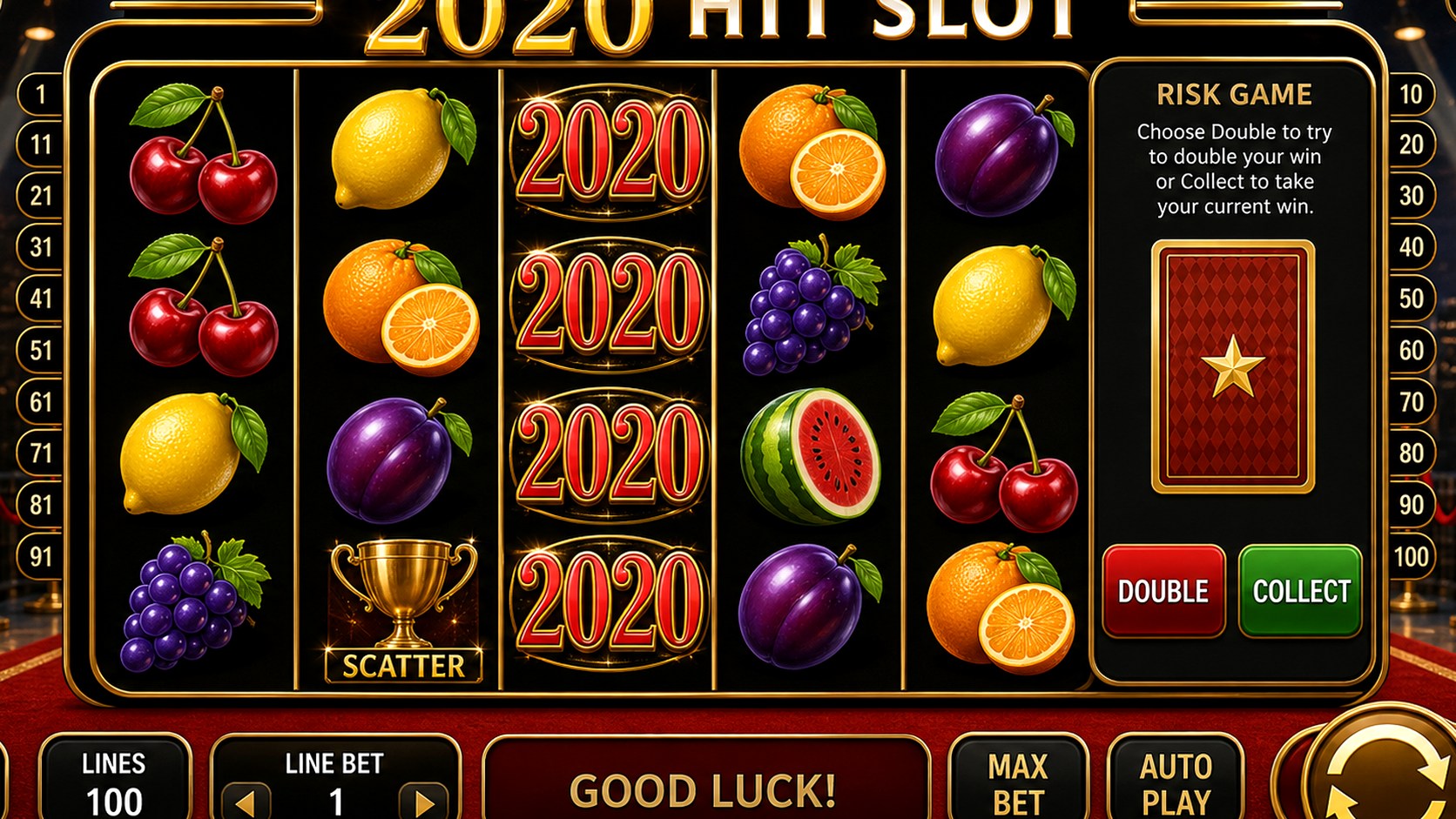
By Fairy Editorial - 21 Aug 2026
Queenie Review: A Wonderland Wheel With Five Different Ways to Change a Spin
Queenie
Queenie Review: A Wonderland Wheel With Five Different Ways to Change a Spin

Queenie makes its central mechanism visible early: wheel pointer, free-spin counter and four jackpot labels. The same game overview lists fixed jackpots of 20, 50, 200 and 4,000 times total stake, with Boost cards able to raise them inside the pick round. The useful question is not how loud the feature looks, but how each debit becomes a traceable credit. Pragmatic Play product material for Wild Streak Gaming lists five reels, 243 ways, twelve symbols, a Wild on reels two through four, a 96.51 percent default return and a 4,200-times maximum; the Wheel can award 8 to 200 times stake, a 2 to 100 times current-win multiplier, random Wilds, free spins or the jackpot game. Exact regional terms still belong to the running client. The three landscape pictures are original editorial reconstructions based on the studio overview and public help rules. They are not Wild Streak Gaming screenshots or proof of a wheel or jackpot result. This review uses a strict evidence order. The deployed help screen ranks first, then a studio sheet, studio product page, regulated operator rules and finally independent catalogues. Artwork proves theme and identity; it does not prove reel strips, probability, feature frequency or an operator return setting. No paid wager was placed and no age gate was bypassed. The accessible pages did not expose a legally open client that could be tested without confirmation, so there is no claimed personal hit rate, balance result or bonus sample. Published mechanics are mapped to checks that can be repeated when the Philippine build is opened by an eligible user. The three wide pictures keep the discussion concrete on a phone-shaped canvas. Their values, counters and positions are explanatory props. They must not be presented as original studio screenshots or as evidence of a win.

A useful test session should therefore be recorded as a sequence rather than remembered as a mood. Note the selected stake, starting balance, round identifier, ordinary line or ways return, feature entry cost, each modifier, every counter movement and the final credited amount. That record cannot predict later rounds, but it can expose a misunderstood rule, a missed reset or a display total that needs support review. The same discipline applies to comparisons with related titles. Shared characters and familiar symbols do not guarantee shared mathematics. A sequel may change its reel strips, return setting, bonus price, maximum award or retrigger schedule while preserving almost the same artwork. This article treats the exact named version as its own product and avoids transferring assumptions from neighbouring games in the catalogue.

Court Opens on the Wonderland Board

Queenie opens with courtroom cross-examination. The imperious Queen of Hearts and White Rabbit portraits, Mad Hatter hats, roses, card suits, Wild hearts, prize-wheel slices and jackpot cards are not background ornaments; they form a visual hierarchy that tells the eye where to look before any rule has been read. The reel area sits inside that hierarchy, so symbols remain distinct from the scenery instead of dissolving into it.

That first reading matters on a phone. A slot may spend heavily on illustration and still fail if the stake, spin control or settled result is hard to locate. Here the strongest idea is not mere decoration. It is the way crimson velvet, ivory card stock, black lacquer and antique gold separates the game board, framing art and controls into layers.

The Studio Record

Pragmatic Play product material for Wild Streak Gaming lists five reels, 243 ways, twelve symbols, a Wild on reels two through four, a 96.51 percent default return and a 4,200-times maximum; the Wheel can award 8 to 200 times stake, a 2 to 100 times current-win multiplier, random Wilds, free spins or the jackpot game. The same game overview lists fixed jackpots of 20, 50, 200 and 4,000 times total stake, with Boost cards able to raise them inside the pick round.

These published figures define the review frame. The active information panel still outranks catalogue copy for the return variant, stake range, cash limit and any disabled feature in the operator build.

Reading the 96.51 Percent Filing

The studio overview lists a 96.51 percent default return. Other regulated deployments can carry lower variants, so the active help panel must be read before the number is repeated as local fact.

The product is commonly classified as high volatility. A wheel that can award a small cash amount, a large multiplier or a jackpot branch naturally creates a wide spread of outcomes.

The Wheel Is a Branching Rule

The word Queenie is the headline hook. It raises an obvious question: does it describe a multiplier, a progression, a visual motif or simply the scale of the story? Only the help screen can answer that. A number or power word in a logo is not automatically the highest cash ratio for a paid round.

Before treating the title as a promise, locate the line that defines it. Check the triggering symbols, the stage at which the value applies, any stake multiplier, the cap on simultaneous wins and any separate cash ceiling. If those conditions are absent, the name should remain a marketing label rather than a calculation.

Five Reels and 243 Ways

The reconstruction follows the confirmed five-reel, three-row, 243-ways format. The deployed help file must still confirm regional return variants, buy-feature availability, stake limits and jurisdictional caps.

The board shape is only the first part of settlement. A player must also verify direction, minimum match length, line or ways unit, Wild exclusions and how simultaneous components are added.

Queen, Rabbit, Hat and Card Suits

The theme naturally divides the reel set into character or object symbols, special icons and playing-card suits and Wonderland objects. White Rabbit portraits, Mad Hatter hats, roses, card suits, Wild hearts, prize-wheel slices and jackpot cards carry more visual weight than the letters and numbers. That weight usually signals premium status, but the paytable may rank two similar objects very differently. Size and shine are clues, never final values.

Read every payout in the unit used by the game. Some tables show bet-per-line units; others use total stake. A five-of-a-kind figure can appear ten or twenty times larger if the unit is misunderstood. The cash meter after a test spin is useful, but the written help panel should settle the conversion.

Low Symbols in a Crowded Court

playing-card suits and Wonderland objects occupy a large share of ordinary reel time in the editorial layout. They create visual breathing room around the premium art and make small combinations quick to recognize. Their role in the mathematical model may be larger than their small paytable values suggest because frequency and value are separate parts of return.

A low-symbol hit can light the grid while returning less than the amount staked. That is a paid result, not necessarily a profitable round. The correct comparison is final credit divided by the full spin cost. Animation length, coin count and sound volume do not change that ratio.

How Adjacent Reels Form a Way

Large portraits and objects such as White Rabbit portraits, Mad Hatter hats, roses, card suits, Wild hearts, prize-wheel slices and jackpot cards can dominate the frame. The practical test is to follow one settled combination from its first symbol to its last without relying on flashing borders. Clear spacing between reels, consistent icon silhouettes and a visible route make the result easier to audit.

If several awards arrive together, open the win breakdown or history panel. One total may contain multiple lines, an anywhere payment and a modifier. Treating the largest symbol on screen as the sole cause can produce a false reading of the rule, especially when a substitute or multiplier is also present.

The Wild Lives on the Middle Reels

The Wild substitutes for ordinary symbols and appears on reels two, three and four in the studio overview. Its position matters because ways still begin on reel one and move through adjacent reels.

A Wild can also create access to the Wheel through the version described in the product sheet. The substitution win and the triggered wheel are separate settlement components.

What Actually Calls the Wheel

The public help rules show that three Wheel symbols trigger the Wheel in the base game, while one or two may trigger it randomly. In free games, one or more Wheel symbols award the Wheel.

This distinction prevents a common error: a single base-game symbol is not a guaranteed trigger, while the same visible count inside free games can have a different rule.

Five Wheel Outcomes, Five Ledgers

The Wheel can stop on a direct award, a current-win multiplier, added Wilds, free games or the jackpot game. Each slice either settles now, modifies the existing spin or opens another stage.

A direct 8-to-200-times prize has no further reel requirement. Random Wilds must be placed before the ways are evaluated, while a multiplier is applied to the qualifying current ways win.

Base Spins Before the Pointer Moves

Many reviews rush past the paid reels and treat the bonus as the only meaningful part. That misses the money path. Base spins create nearly all turnover, settle small and medium awards, and decide how long a balance remains available. A rare feature cannot repair a stake level that is too high for the intended session.

Queenie needs ordinary results that are readable at a glance. A clean board lets the user distinguish a no-win, a partial return and a profit without waiting for a long count-up. That clarity is especially important when the surrounding crimson Wonderland court and card palace is busy and the screen uses strong motion.

Free Games and Guaranteed Wheel Access

A free-game slice starts the count stated on that slice; studio material describes a range from 10 to 100 in one overview, while a later jurisdictional help file lists 8 to 50. That variation proves why the deployed rules matter.

Inside free games the Wheel triggers whenever qualifying Wheel access appears under that build, and another free-game result adds actions. Special reels may alter the symbol distribution.

Multipliers Apply to the Current Ways Win

The Wheel multiplier applies to the total ways win of the current base or free game, with the studio overview listing values from 2 times to 100 times.

It does not multiply the account balance, direct wheel cash, future spins or fixed jackpots unless the help text expressly says so. Scope matters more than the number printed on the slice.

The 4,200x Maximum and Four Fixed Jackpots

Clients often label results with tiers such as big, mega or super. Those labels are commonly based on the ratio between win and current stake. They do not prove that the result reached the mathematical ceiling. The count-up may also stop at a cash cap even when the theoretical symbol total is higher.

To calculate a genuine ratio, divide the credited result by the total stake removed for the paid round. Include free follow-up actions inside that same round unless the rules state otherwise. This method turns a loud presentation into a comparable number and avoids confusing coins on screen with peso value.

Picture One: Wonderland Reconstruction

The first picture reconstructs the Queen, Rabbit, five-by-three board and large wheel on one phone-wide stage. Its amounts and symbol positions exist for explanation only.

The illustration belongs to the editorial layer. It cannot certify probability, reel strips, a balance or a real feature trigger.

Picture Two: Wild and Wheel Close-Up

The second picture moves closer to the middle-reel Wild and 243-ways grid. It supports a discussion of adjacency and substitution without documenting a paid outcome.

The close view helps separate symbol roles and screen zones. The client history remains the correct evidence for a settled round.

Picture Three: Jackpot and Free-Game Branches

The third picture concentrates on the jackpot names, card-pick idea and free-spin slice. It illustrates the branch structure but does not assert that the illustrated prizes were available in one regional build.

The image turns a complicated rule tree into visible parts, but only the live rules establish which parts can coexist.

Royal docket 19: Sound Design and Perceived Pace

courtroom cross-examination can be strengthened through layered music, reel-stop cues and short feature stingers. Sound is useful when it marks a trigger or completed calculation. It becomes less useful when every partial return receives the same fanfare as a clear profit.

Try several rounds with audio lowered. If the board still communicates outcome, the interface is doing its job. If the result becomes ambiguous without a voice line or long count-up, the visual feedback needs more attention. Audio should confirm settlement, not replace the numbers.

Royal docket 20: Landscape Play and Thumb Reach

A horizontal phone gives the crimson Wonderland court and card palace room on both sides of the reels. The central board remains large while settings, stake controls and spin can occupy the lower band. This arrangement works best when the largest button sits away from the minus and plus controls.

Before rapid play, rotate the device, enter full screen and check the total-stake field after one adjustment. Browser bars and system gestures can cover edge controls. A test spin at the minimum setting confirms that the hit boxes match the visible buttons and that no accidental Max Bet control sits beneath the thumb.

Royal docket 21: Portrait Mode Is a Compromise

Portrait layout may scale the entire game down or reorganize controls beneath the grid. Tiny payline markers and condensed help text are the first casualties. The screen can remain playable, yet accurate rule reading becomes harder when the table requires repeated zooming or horizontal swipes.

Use portrait mode for quick navigation, not for the first rules check. Landscape is the better place to compare total stake, balance and win because all three can remain visible together. The relationship between those numbers matters more than keeping the device in one hand.

Royal docket 22: Performance on Mid-Range Phones

The artwork uses multiple layers, large character cutouts and particle effects. On a mid-range handset, watch for delayed button response after a count-up, audio falling out of step with the reels or a stake change taking effect one round late. Those are interface problems, not signs of altered probability.

Close other heavy apps and use a stable connection during the first session. If the client reconnects, verify balance and the last completed round in history before spinning again. A frozen animation can recover after the server has already settled the result, so the account record takes priority over the last visible frame.

Royal docket 23: Stake Controls Deserve More Attention Than the Mascot

A wheel combines cash, modifiers, Wild placement, free games and jackpots on one display, so the pointer animation can blur the distinction between a direct award and a chance to enter another random stage. The most useful habit is to read total stake after every change and before the first rapid sequence. Bet per line, coin value and total bet may occupy separate fields, and altering one can multiply the final debit.

A planned session should be written in money, spins and time. Divide the session amount by the intended number of paid rounds to find a workable average stake. Free actions do not add a new debit unless the client states a purchase. This arithmetic is dull, but it controls exposure more reliably than any theme-based hunch.

Royal docket 24: RTP Belongs to Turnover, Not a Short Run

Once the deployed RTP is known, interpret it as a long-run model ratio. If the help page lists 96 percent, theoretical cost is four units per hundred units of turnover. That sentence is an example of the calculation, not a claim that this version uses 96 percent.

Turnover equals total paid stake across accepted rounds. A hundred spins at one unit create one hundred units of turnover even if several free actions appear between them. A short session may finish far above or below the model ratio because random outcomes do not settle into a neat percentage on demand.

Royal docket 25: Volatility Is About Distribution

Volatility describes how payout value is spread across outcomes. A higher band usually places more weight in less common large results; a lower band usually returns more of its value through smaller payments. The label does not state when a feature will arrive or how long a losing sequence can last.

Without an official band, infer nothing from courtroom cross-examination. A calm fruit village can use severe math, and a battlefield can use a mild distribution. After the label is found, use it to size stake and session length, not to forecast the next reel stop.

Royal docket 26: Maximum Win Needs a Denominator

The studio overview caps the game at 4,200 times total stake. Its fixed jackpots are listed as Mini 20 times, Minor 50 times, Major 200 times and Grand 4,000 times before any permitted Boost.

A Boost card can raise the fixed values during the pick round, but the total game cap still controls settlement. Match-three card selection reveals a random award; it is not a skill test.

Royal docket 27: A Clean Demo Test in Thirty Paid Rounds

Use the minimum fixed stake and create one row for each paid round. Record starting balance, debit, base credit, feature credit, ending balance and any meter change. Keep free actions inside the row of the spin that triggered them. This format exposes the money flow without treating a tiny sample as statistical proof.

Thirty rounds are enough to learn button behavior, symbol settlement and feature messages. They are not enough to estimate RTP or trigger frequency. The purpose is mechanical literacy. Stop the test once each major control has been checked; more spins do not turn an informal sample into certification.

Royal docket 28: How to Audit a Bonus From Start to Finish

Capture the trigger screen, starting counter, carried stake and opening multiplier. Then note each retrigger, held symbol, expanding reel or meter reset. At the end, compare the feature total with the history record and final balance. Every free action should trace back to one paid round.

If a purchase button exists, treat it as a separate bet mode. Record its price as the full stake for that round and read its RTP entry independently if the client lists one. A purchased feature may use the same animation while carrying a different cost structure.

Royal docket 29: Common Misreads Around Queenie

The first misread is assuming that Queenie states the unconditional top award. The second is assigning premium status solely from symbol size. The third is treating a filling wheel pointer, free-spin counter and four jackpot labels as proof that a feature is due. The fourth is calling every substitute a multiplier Wild without checking the rules.

The fifth is copying an RTP from an unrelated review. The sixth is counting free actions as fresh paid spins. The seventh is judging profit from the win banner instead of balance movement. Each mistake disappears when the player keeps the stake field, history panel and help page in the same audit.

Royal docket 30: What Philippine Players Should Verify

A Philippine listing may use peso values, wallet credits or a converted coin display. Confirm the minimum and maximum total stake, not merely coin size. Check that the operator names Wild Streak Gaming as the studio, and compare the logo with the official key art before assuming that a similarly named title is the same product.

Also read local rules for feature purchases, autoplay, session reminders and cash limits. These controls belong to the operator build and jurisdiction. A screenshot from another market can explain layout, but it cannot establish the available stake range or certified return in a Philippine account.

Royal docket 31: Who Gets the Most From This Theme

Readers who prefer a 243-ways base game whose main event branches into several visibly different outcomes rather than one narrow free-spin script will find the presentation immediately legible. The theme also suits short review sessions because the visual hierarchy can be judged quickly. That does not make the mathematical profile suitable for every budget; the actual volatility and minimum total stake still control that decision.

Anyone who dislikes dense side art or loud event effects should test the sound and fast-play controls first. A strong theme can be a reason to open a demo, but it is not a reason to ignore the paytable. Interest in the artwork and comfort with the stake are separate choices.

Royal docket 32: A Practical Decision Checklist

Before real play, confirm the exact title, studio, RTP, volatility, win method, Wild exceptions, Scatter route, feature trigger, multiplier scope, maximum-win denominator and cash cap. Then set a total session amount and a stopping time. If any critical rule remains hidden, keep the title in demo mode.

During play, watch balance rather than animation. After play, compare opening balance, deposits, withdrawals and ending balance with the history log. This checklist does not change random results. It changes how clearly the cost and settlement can be seen.

Royal docket 33: Final Reading: Theme First, Math Before Money

Queenie is strongest when treated as a branching settlement system. The wheel can close the event immediately, modify the current ways win or open a longer feature, and each branch needs a separate denominator and history entry

Queenie earns attention through courtroom cross-examination and a tightly coordinated crimson velvet, ivory card stock, black lacquer and antique gold palette. The next step is not a larger stake; it is the local information screen. Confirm the deployed math, test the controls at minimum value and treat every visual promise as a question that the rules must answer.

Royal docket 34: Separating Hit Rate From Profit Rate

A hit is any result the rules count as a payment. Profit requires the credited amount to exceed the full stake for that paid round. A title can register frequent small hits while the balance declines. Without an official hit-frequency figure, the only safe statement is that the two rates are not interchangeable.

For a demo log, mark return ratios below 1x, exactly 1x and above 1x in separate columns. This reveals how many recorded wins were partial returns. It still does not predict future play, but it gives a much clearer account of the sample than a simple count of flashing win messages.

Royal docket 35: Near Misses Are Animation, Not Progress

A bonus icon stopping just outside a payline or a premium symbol passing during reel motion can feel meaningful. Unless the written rule stores that event, it has no carry-over value. The next accepted round is not improved because the previous animation looked close.

The same caution applies to two trigger symbols when three are required. They may create suspense, yet their payment and stored effect depend entirely on the table. Record what was credited, then clear the image from the decision about the next stake.

Royal docket 36: Fast Play Changes Exposure Speed

Fast play shortens animation; it does not normally change the random model. Its financial effect comes from time. More paid rounds can fit into the same minute, so the balance may move faster even though the stake per round stays fixed.

Measure pace before enabling it. Ten ordinary rounds on standard speed and ten on fast speed reveal the difference in turnover per minute. If the faster rate breaks the planned session limit, lower the stake or return to standard timing rather than relying on attention alone.

Royal docket 37: Autoplay Needs Stop Conditions

Where autoplay is available, set a round count and use any loss, win or single-award limits shown by the client. Read those fields carefully because some are cash values while others are stake multipliers. An empty field may mean no automatic stop for that condition.

Remain present during automated rounds. Network reconnection, a feature choice or a changed balance can pause the sequence. Autoplay is a convenience control, not a budget system, and it does not make a long sample more likely to follow the theoretical return.

Royal docket 38: Responsible Play in Plain Numbers

Set a sum that can be lost without affecting bills, savings or debt payments. Do not borrow to play, do not chase a prior loss and do not treat a rare large result as income. Time reminders and deposit limits are useful because strong game art can blur the length of a session.

If play stops feeling optional, close the client and use the operator exclusion or limit tools. The clearest review of any slot ends with the same fact: outcomes are random, the house keeps a mathematical margin over long turnover and no visual pattern creates a reliable edge.
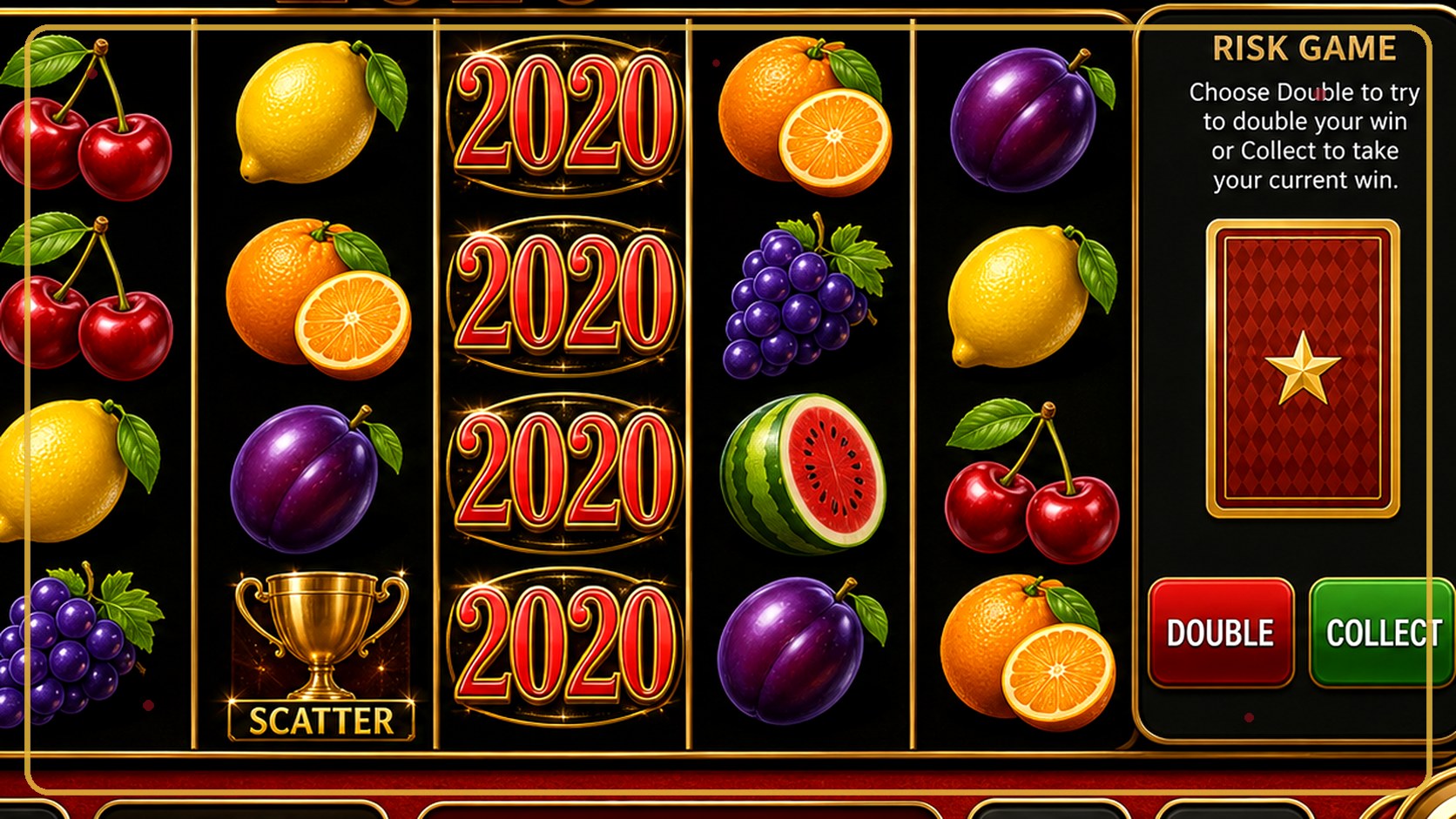
By Fairy Editorial - 21 Aug 2026
Alaskan Fishing Review: Two Bonus Routes Hidden Behind a Quiet 243-Ways Grid
Alaskan Fishing
Alaskan Fishing Review: Two Bonus Routes Hidden Behind a Quiet 243-Ways Grid

Alaskan Fishing is easier to judge when its old-school presentation is separated from its accounting. One accessible regulated rules page lists a 96.0 percent return and a £250,000 cash ceiling, while independent catalogues identify higher return variants, so the number in the loaded client must take priority. The review therefore follows each debit, trigger, modifier and credited component instead of rating the scenery alone. Published operator rules for the Games Global edition confirm five reels, three rows, 243 permanent ways, a Wild that can stack, three or more Scatters awarding fifteen free spins, ordinary free-spin wins doubled, and two Bonus symbols on reels one and five opening a five-pick Fly Fishing round. Exact operator terms still belong to the deployed information panel. The three horizontal pictures are original editorial reconstructions based on published rules. They are not Games Global screenshots, do not record a wager and do not prove that the displayed symbols landed together. This article uses a strict evidence order: deployed help screen, studio catalogue, regulated operator rules and independent directory. Artwork can establish theme and symbol identity, but it cannot establish reel strips, probability, bonus frequency or the return setting selected by a particular operator. No paid wager was placed and no age-confirmation screen was bypassed. The available pages did not expose a complete lawful client for direct testing without eligibility confirmation, so there is no claimed personal hit rate or bonus sample. The analysis instead turns every published mechanism into a repeatable check for an eligible Philippine user. A useful test record includes the selected stake, active lines or ways, starting balance, round identifier, feature entry, each counter movement, component awards and final credit. It cannot forecast later rounds, but it can reveal a misunderstood rule or a settlement that requires operator support. Comparisons with newer fishing or exploration games also need care. Shared subjects do not create shared mathematics. A later release may alter its reel strips, volatility, bonus cost, retrigger rule or maximum credit while borrowing familiar characters and objects. The exact title and deployed help file define the product reviewed here; assumptions from a sequel or similarly named mobile cabinet are kept outside the calculation. The three landscape pictures are explanatory mobile compositions. Their balances, symbol positions and values are props. They must not be reused as proof that a feature triggered or that a stated amount was won.

Setting Up Beside the Ice Lake

Alaskan Fishing opens with cold-water field notes. The rugged fisherman Wild and eagles, bears, moose, salmon, trout, tackle boxes, lake Scatters and Fly Fishing symbols are not background ornaments; they form a visual hierarchy that tells the eye where to look before any rule has been read. The reel area sits inside that hierarchy, so symbols remain distinct from the scenery instead of dissolving into it.

That first reading matters on a phone. A slot may spend heavily on illustration and still fail if the stake, spin control or settled result is hard to locate. Here the strongest idea is not mere decoration. It is the way glacier blue, evergreen, silver and weathered cabin wood separates the game board, framing art and controls into layers.

What the Operator Rules Confirm

Published operator rules for the Games Global edition confirm five reels, three rows, 243 permanent ways, a Wild that can stack, three or more Scatters awarding fifteen free spins, ordinary free-spin wins doubled, and two Bonus symbols on reels one and five opening a five-pick Fly Fishing round. One accessible regulated rules page lists a 96.0 percent return and a £250,000 cash ceiling, while independent catalogues identify higher return variants, so the number in the loaded client must take priority.

This is the evidence boundary used here. The active client remains decisive for regional settings, stake units, optional controls and any later certified revision.

Why the Listed Return Can Differ

An accessible regulated rule file lists 96.0 percent for its deployed version, while independent catalogues report 96.63 percent for another configuration. The gap is not a rounding error; it shows that the same title can be distributed with more than one return setting.

Read the in-game number before comparing the title with another site. A higher catalogue figure cannot be transferred to an operator build whose help panel prints a lower one.

Two Bonuses With Separate Jobs

The word Fishing is the headline hook. It raises an obvious question: does it describe a multiplier, a progression, a visual motif or simply the scale of the story? Only the help screen can answer that. A number or power word in a logo is not automatically the highest cash ratio for a paid round.

Before treating the title as a promise, locate the line that defines it. Check the triggering symbols, the stage at which the value applies, any stake multiplier, the cap on simultaneous wins and any separate cash ceiling. If those conditions are absent, the name should remain a marketing label rather than a calculation.

Five Reels and 243 Permanent Ways

The reconstruction follows the confirmed five-by-three, 243-ways layout. Operator-specific coin size, bet multiplier, return setting, maximum cash credit and optional controls must still be read in the running client.

Geometry alone never settles a result. The help screen must also state the direction of wins, minimum matching count, active-line or ways unit, substitution exclusions and how simultaneous awards are combined.

Wildlife, Fish and Fishing Gear

The theme naturally divides the reel set into character or object symbols, special icons and smaller fish and outdoor equipment. eagles, bears, moose, salmon, trout, tackle boxes, lake Scatters and Fly Fishing symbols carry more visual weight than the letters and numbers. That weight usually signals premium status, but the paytable may rank two similar objects very differently. Size and shine are clues, never final values.

Read every payout in the unit used by the game. Some tables show bet-per-line units; others use total stake. A five-of-a-kind figure can appear ten or twenty times larger if the unit is misunderstood. The cash meter after a test spin is useful, but the written help panel should settle the conversion.

Small Symbols Across a Wide Board

smaller fish and outdoor equipment occupy a large share of ordinary reel time in the editorial layout. They create visual breathing room around the premium art and make small combinations quick to recognize. Their role in the mathematical model may be larger than their small paytable values suggest because frequency and value are separate parts of return.

A low-symbol hit can light the grid while returning less than the amount staked. That is a paid result, not necessarily a profitable round. The correct comparison is final credit divided by the full spin cost. Animation length, coin count and sound volume do not change that ratio.

Following One Adjacent-Reel Way

Large portraits and objects such as eagles, bears, moose, salmon, trout, tackle boxes, lake Scatters and Fly Fishing symbols can dominate the frame. The practical test is to follow one settled combination from its first symbol to its last without relying on flashing borders. Clear spacing between reels, consistent icon silhouettes and a visible route make the result easier to audit.

If several awards arrive together, open the win breakdown or history panel. One total may contain multiple lines, an anywhere payment and a modifier. Treating the largest symbol on screen as the sole cause can produce a false reading of the rule, especially when a substitute or multiplier is also present.

The Fisherman Wild Can Stack

The fisherman substitutes for ordinary symbols but not the Scatter or Bonus. He also has his own pays when a matching Wild way begins on reel one.

More than one Wild may occupy a reel, forming a stack. Because each position can participate in separate adjacent-reel ways, a stack can multiply the number of qualifying routes without changing the paytable value itself.

Scatters Start the Fifteen-Spin Route

Three or more lake Scatters anywhere on the board pay a Scatter award and start fifteen free spins. Three more during the feature add another fifteen to the remaining counter.

Scatter calculation uses total coins bet rather than an active way. That unit is different from an ordinary symbol pay, so the history should display the two components separately.

The Outer-Reel Fly Fishing Trigger

The Fly Fishing round needs two Bonus symbols, specifically on reels one and five. Their outer-reel positions matter more than simple symbol count.

Once triggered, five fishing spots are selected and every revealed amount is added. The choice changes the order of reveal, not the published random award distribution, unless the rules expressly describe skill.

Base Spins Before Either Bonus

Many reviews rush past the paid reels and treat the bonus as the only meaningful part. That misses the money path. Base spins create nearly all turnover, settle small and medium awards, and decide how long a balance remains available. A rare feature cannot repair a stake level that is too high for the intended session.

Alaskan Fishing needs ordinary results that are readable at a glance. A clean board lets the user distinguish a no-win, a partial return and a profit without waiting for a long count-up. That clarity is especially important when the surrounding cold Alaskan lake beneath pine forest and snow mountains is busy and the screen uses strong motion.

Fifteen Spins With Ordinary Wins Doubled

Free spins retain the last paid bet and start with fifteen actions. Ordinary wins are doubled, and the Scatter can add blocks of another fifteen.

The cleanest audit records the pre-feature stake, starting counter, every retrigger, the ordinary ways total before x2 and the final credit.

Why x2 Does Not Cover the Pick Round

The x2 applies to regular free-spin wins. Published rules explicitly exclude Fly Fishing Bonus amounts, even if that pick round is reached while free spins are active.

This scope prevents double counting. Add doubled regular components, any Scatter award and the unmultiplied pick total in the order shown by history.

Reading the Cash Ceiling Correctly

Clients often label results with tiers such as big, mega or super. Those labels are commonly based on the ratio between win and current stake. They do not prove that the result reached the mathematical ceiling. The count-up may also stop at a cash cap even when the theoretical symbol total is higher.

To calculate a genuine ratio, divide the credited result by the total stake removed for the paid round. Include free follow-up actions inside that same round unless the rules state otherwise. This method turns a loud presentation into a comparable number and avoids confusing coins on screen with peso value.

Picture One: Alaskan Reconstruction

The first picture combines the five-by-three lake board, fisherman Wild, wildlife symbols and two outer Bonus panels in one wide view. It is newly produced review art rather than a captured client.

The picture supports visual analysis only. It cannot certify reel strips, probability, a balance or a real trigger.

Picture Two: Stacked Wild and Ways

The second picture moves toward the stacked-Wild and adjacent-reel area. It makes the 243-ways route easier to discuss, but the visible screen is not a settled result.

The closer crop is useful for symbol roles and board spacing. A transaction history remains stronger evidence for every credited component.

Picture Three: Free Spins and Five Picks

The third picture isolates the fifteen-spin counter, x2 marker and five fishing spots. It maps the two bonus systems without implying that both were triggered in a real session.

The final image is a rule map rather than a result claim. Values and positions are props created for this article.

Fishing journal 19: Sound Design and Perceived Pace

cold-water field notes can be strengthened through layered music, reel-stop cues and short feature stingers. Sound is useful when it marks a trigger or completed calculation. It becomes less useful when every partial return receives the same fanfare as a clear profit.

Try several rounds with audio lowered. If the board still communicates outcome, the interface is doing its job. If the result becomes ambiguous without a voice line or long count-up, the visual feedback needs more attention. Audio should confirm settlement, not replace the numbers.

Fishing journal 20: Landscape Play and Thumb Reach

A horizontal phone gives the cold Alaskan lake beneath pine forest and snow mountains room on both sides of the reels. The central board remains large while settings, stake controls and spin can occupy the lower band. This arrangement works best when the largest button sits away from the minus and plus controls.

Before rapid play, rotate the device, enter full screen and check the total-stake field after one adjustment. Browser bars and system gestures can cover edge controls. A test spin at the minimum setting confirms that the hit boxes match the visible buttons and that no accidental Max Bet control sits beneath the thumb.

Fishing journal 21: Portrait Mode Is a Compromise

Portrait layout may scale the entire game down or reorganize controls beneath the grid. Tiny payline markers and condensed help text are the first casualties. The screen can remain playable, yet accurate rule reading becomes harder when the table requires repeated zooming or horizontal swipes.

Use portrait mode for quick navigation, not for the first rules check. Landscape is the better place to compare total stake, balance and win because all three can remain visible together. The relationship between those numbers matters more than keeping the device in one hand.

Fishing journal 22: Performance on Mid-Range Phones

The artwork uses multiple layers, large character cutouts and particle effects. On a mid-range handset, watch for delayed button response after a count-up, audio falling out of step with the reels or a stake change taking effect one round late. Those are interface problems, not signs of altered probability.

Close other heavy apps and use a stable connection during the first session. If the client reconnects, verify balance and the last completed round in history before spinning again. A frozen animation can recover after the server has already settled the result, so the account record takes priority over the last visible frame.

Fishing journal 23: Stake Controls Deserve More Attention Than the Mascot

The peaceful scenery and frequent small ways combinations can make turnover feel slower than it is, while the separate pick feature encourages attention to revealed spots instead of the full paid-round cost. The most useful habit is to read total stake after every change and before the first rapid sequence. Bet per line, coin value and total bet may occupy separate fields, and altering one can multiply the final debit.

A planned session should be written in money, spins and time. Divide the session amount by the intended number of paid rounds to find a workable average stake. Free actions do not add a new debit unless the client states a purchase. This arithmetic is dull, but it controls exposure more reliably than any theme-based hunch.

Fishing journal 24: RTP Belongs to Turnover, Not a Short Run

Once the deployed RTP is known, interpret it as a long-run model ratio. If the help page lists 96 percent, theoretical cost is four units per hundred units of turnover. That sentence is an example of the calculation, not a claim that this version uses 96 percent.

Turnover equals total paid stake across accepted rounds. A hundred spins at one unit create one hundred units of turnover even if several free actions appear between them. A short session may finish far above or below the model ratio because random outcomes do not settle into a neat percentage on demand.

Fishing journal 25: Volatility Is About Distribution

Volatility describes how payout value is spread across outcomes. A higher band usually places more weight in less common large results; a lower band usually returns more of its value through smaller payments. The label does not state when a feature will arrive or how long a losing sequence can last.

Without an official band, infer nothing from cold-water field notes. A calm fruit village can use severe math, and a battlefield can use a mild distribution. After the label is found, use it to size stake and session length, not to forecast the next reel stop.

Fishing journal 26: Maximum Win Needs a Denominator

One regulated page states a £250,000 maximum cash win for its version. That is a currency ceiling, not a universal stake multiplier and not necessarily the limit used by a Philippine operator.

A separate paytable can also contain a highest symbol combination. Do not confuse that coinciding symbol pay with the maximum possible full round after Scatters, free spins and a pick feature are added.

Fishing journal 27: A Clean Demo Test in Thirty Paid Rounds

Use the minimum fixed stake and create one row for each paid round. Record starting balance, debit, base credit, feature credit, ending balance and any meter change. Keep free actions inside the row of the spin that triggered them. This format exposes the money flow without treating a tiny sample as statistical proof.

Thirty rounds are enough to learn button behavior, symbol settlement and feature messages. They are not enough to estimate RTP or trigger frequency. The purpose is mechanical literacy. Stop the test once each major control has been checked; more spins do not turn an informal sample into certification.

Fishing journal 28: How to Audit a Bonus From Start to Finish

Capture the trigger screen, starting counter, carried stake and opening multiplier. Then note each retrigger, held symbol, expanding reel or meter reset. At the end, compare the feature total with the history record and final balance. Every free action should trace back to one paid round.

If a purchase button exists, treat it as a separate bet mode. Record its price as the full stake for that round and read its RTP entry independently if the client lists one. A purchased feature may use the same animation while carrying a different cost structure.

Fishing journal 29: Common Misreads Around Alaskan Fishing

The first misread is assuming that Fishing states the unconditional top award. The second is assigning premium status solely from symbol size. The third is treating a filling free-spin counter, x2 ordinary-win marker and five fishing picks as proof that a feature is due. The fourth is calling every substitute a multiplier Wild without checking the rules.

The fifth is copying an RTP from an unrelated review. The sixth is counting free actions as fresh paid spins. The seventh is judging profit from the win banner instead of balance movement. Each mistake disappears when the player keeps the stake field, history panel and help page in the same audit.

Fishing journal 30: What Philippine Players Should Verify

A Philippine listing may use peso values, wallet credits or a converted coin display. Confirm the minimum and maximum total stake, not merely coin size. Check that the operator names Games Global as the studio, and compare the logo with the official key art before assuming that a similarly named title is the same product.

Also read local rules for feature purchases, autoplay, session reminders and cash limits. These controls belong to the operator build and jurisdiction. A screenshot from another market can explain layout, but it cannot establish the available stake range or certified return in a Philippine account.

Fishing journal 31: Who Gets the Most From This Theme

Readers who prefer an older 243-ways structure with two plainly separated bonuses rather than a modern screen filled with overlapping meters will find the presentation immediately legible. The theme also suits short review sessions because the visual hierarchy can be judged quickly. That does not make the mathematical profile suitable for every budget; the actual volatility and minimum total stake still control that decision.

Anyone who dislikes dense side art or loud event effects should test the sound and fast-play controls first. A strong theme can be a reason to open a demo, but it is not a reason to ignore the paytable. Interest in the artwork and comfort with the stake are separate choices.

Fishing journal 32: A Practical Decision Checklist

Before real play, confirm the exact title, studio, RTP, volatility, win method, Wild exceptions, Scatter route, feature trigger, multiplier scope, maximum-win denominator and cash cap. Then set a total session amount and a stopping time. If any critical rule remains hidden, keep the title in demo mode.

During play, watch balance rather than animation. After play, compare opening balance, deposits, withdrawals and ending balance with the history log. This checklist does not change random results. It changes how clearly the cost and settlement can be seen.

Fishing journal 33: Final Reading: Theme First, Math Before Money

Alaskan Fishing remains mechanically readable because its two bonus paths do different jobs. Scatters start a retriggerable x2 free-spin state, while outer-reel Bonus symbols open a five-pick cash round whose awards are added without the free-spin multiplier

Alaskan Fishing earns attention through cold-water field notes and a tightly coordinated glacier blue, evergreen, silver and weathered cabin wood palette. The next step is not a larger stake; it is the local information screen. Confirm the deployed math, test the controls at minimum value and treat every visual promise as a question that the rules must answer.

Fishing journal 34: Separating Hit Rate From Profit Rate

A hit is any result the rules count as a payment. Profit requires the credited amount to exceed the full stake for that paid round. A title can register frequent small hits while the balance declines. Without an official hit-frequency figure, the only safe statement is that the two rates are not interchangeable.

For a demo log, mark return ratios below 1x, exactly 1x and above 1x in separate columns. This reveals how many recorded wins were partial returns. It still does not predict future play, but it gives a much clearer account of the sample than a simple count of flashing win messages.

Fishing journal 35: Near Misses Are Animation, Not Progress

A bonus icon stopping just outside a payline or a premium symbol passing during reel motion can feel meaningful. Unless the written rule stores that event, it has no carry-over value. The next accepted round is not improved because the previous animation looked close.

The same caution applies to two trigger symbols when three are required. They may create suspense, yet their payment and stored effect depend entirely on the table. Record what was credited, then clear the image from the decision about the next stake.

Fishing journal 36: Fast Play Changes Exposure Speed

Fast play shortens animation; it does not normally change the random model. Its financial effect comes from time. More paid rounds can fit into the same minute, so the balance may move faster even though the stake per round stays fixed.

Measure pace before enabling it. Ten ordinary rounds on standard speed and ten on fast speed reveal the difference in turnover per minute. If the faster rate breaks the planned session limit, lower the stake or return to standard timing rather than relying on attention alone.

Fishing journal 37: Autoplay Needs Stop Conditions

Where autoplay is available, set a round count and use any loss, win or single-award limits shown by the client. Read those fields carefully because some are cash values while others are stake multipliers. An empty field may mean no automatic stop for that condition.

Remain present during automated rounds. Network reconnection, a feature choice or a changed balance can pause the sequence. Autoplay is a convenience control, not a budget system, and it does not make a long sample more likely to follow the theoretical return.

Fishing journal 38: Responsible Play in Plain Numbers

Set a sum that can be lost without affecting bills, savings or debt payments. Do not borrow to play, do not chase a prior loss and do not treat a rare large result as income. Time reminders and deposit limits are useful because strong game art can blur the length of a session.

If play stops feeling optional, close the client and use the operator exclusion or limit tools. The clearest review of any slot ends with the same fact: outcomes are random, the house keeps a mathematical margin over long turnover and no visual pattern creates a reliable edge.
By Fairy Editorial - 21 Aug 2026
Hop Review: Golden Eggs, Connected Wins and a 60,000x Ceiling
Hop
Hop Review: Golden Eggs, Connected Wins and a 60,000x Ceiling

Hop puts its premise on screen before the first paid action: The same listing dates the release to 2 April 2026, but its playable client stopped behind a verification page during this review. The visible theme gives the review a place to start, but it cannot fill gaps in the rule sheet. A public Venture Studios game listing describes Hop as a 5 by 3 high-volatility title with Connected Wins, a 96 percent return, a 4 percent edge and a maximum award of 60000 times stake; it also names golden-egg Scatters, free spins, a Super Wild multiplier wheel and feature-purchase modes. Exact values from the active operator build take priority wherever public records are absent, contradictory or inaccessible. The three horizontal pictures are editorial reconstructions based on the public mechanism list. They are not Venture Studios screenshots, and the illustrated symbol positions are not a recorded win.

This review uses a narrow evidence hierarchy. A first-party help panel in the deployed game would rank first, followed by a studio product page, then a public lobby record and finally a secondary catalogue. A picture may confirm visual identity, while a text listing may identify a grid or published return. Neither should be stretched into a claim about feature frequency, reel strips, random-number generation or the exact configuration used by a different operator. No paid wager was made for this article. The attempted public clients did not reach a usable game session, so there is no spin diary, hit-rate sample or personal balance result to report. The screen analysis instead asks what a Philippine player should verify once the local build opens: accepted stake, settlement unit, history entry, rule version, return setting, volatility label, maximum-award denominator and any separate cash limit. That is a more dependable review method than inventing a lucky session. The reconstructed pictures are designed to keep the discussion concrete on a phone-sized landscape canvas. Their controls, symbol positions, counters and values are props. They do not certify a pay route and must not be presented later as proof that a feature triggered. Where public material gives a specific layout, the artwork follows that broad structure; where the record is silent, the composition remains openly hypothetical. Every cash statement should still be checked against the accepted-round record after the screen has finished counting and before another action clears the display.

The First Hop Across the Garden

Hop opens with bright spring bustle. The white rabbit guide and carrots, lettuce, lavender, daisies, candy, painted eggs, chicks and chocolate rabbits are not background ornaments; they form a visual hierarchy that tells the eye where to look before any rule has been read. The reel area sits inside that hierarchy, so symbols remain distinct from the scenery instead of dissolving into it.

That first reading matters on a phone. A slot may spend heavily on illustration and still fail if the stake, spin control or settled result is hard to locate. Here the strongest idea is not mere decoration. It is the way sunrise peach, garden green, lavender purple and egg gold separates the game board, framing art and controls into layers.

What the Public Listing Confirms

A public Venture Studios game listing describes Hop as a 5 by 3 high-volatility title with Connected Wins, a 96 percent return, a 4 percent edge and a maximum award of 60000 times stake; it also names golden-egg Scatters, free spins, a Super Wild multiplier wheel and feature-purchase modes. The same listing dates the release to 2 April 2026, but its playable client stopped behind a verification page during this review. This is the firm boundary of the evidence used here.

A catalogue image can establish identity and art direction. It cannot establish the exact RTP setting, volatility band, reel mathematics, bet limits or highest award in every operator build. Those facts belong to the information panel of the version actually loaded.

Reading 96 Percent Beside a 4 Percent Edge

The public listing states a 96 percent return and a 4 percent house edge. Those figures are mathematical complements, which makes the listing internally consistent. They describe long turnover rather than a promise for a short garden session.

The same source labels volatility high and the maximum 60000 times stake. That combination points to a distribution with a remote upper tail, not to a frequent path toward the cap. The operator help page still controls if a regional configuration differs.

Why Hop Is Not the Pay Mechanism

The word Hop is the headline hook. It raises an obvious question: does it describe a multiplier, a progression, a visual motif or simply the scale of the story? Only the help screen can answer that. A number or power word in a logo is not automatically the highest cash ratio for a paid round.

Before treating the title as a promise, locate the line that defines it. Check the triggering symbols, the stage at which the value applies, any stake multiplier, the cap on simultaneous wins and any separate cash ceiling. If those conditions are absent, the name should remain a marketing label rather than a calculation.

The Published 5 by 3 Board

Hop is publicly described as a 5 by 3 game using Connected Wins. The grid is therefore more specific than a decorative preview, but the phrase still needs operational detail: matching symbols may need to begin on the first reel and touch across adjacent columns.

The editorial screen follows the published 5 by 3 geometry. Connected Wins still needs the active help page to define the starting reel, adjacency, minimum symbol count, overlap rules and any different behavior inside free spins.

Eggs, Plants, Candy and Characters

The theme naturally divides the reel set into character or object symbols, special icons and small garden and candy symbols. carrots, lettuce, lavender, daisies, candy, painted eggs, chicks and chocolate rabbits carry more visual weight than the letters and numbers. That weight usually signals premium status, but the paytable may rank two similar objects very differently. Size and shine are clues, never final values.

Read every payout in the unit used by the game. Some tables show bet-per-line units; others use total stake. A five-of-a-kind figure can appear ten or twenty times larger if the unit is misunderstood. The cash meter after a test spin is useful, but the written help panel should settle the conversion.

Quiet Symbols Inside Connected Wins

small garden and candy symbols occupy a large share of ordinary reel time in the editorial layout. They create visual breathing room around the premium art and make small combinations quick to recognize. Their role in the mathematical model may be larger than their small paytable values suggest because frequency and value are separate parts of return.

A low-symbol hit can light the grid while returning less than the amount staked. That is a paid result, not necessarily a profitable round. The correct comparison is final credit divided by the full spin cost. Animation length, coin count and sound volume do not change that ratio.

How Adjacent Matches Need to Connect

Large portraits and objects such as carrots, lettuce, lavender, daisies, candy, painted eggs, chicks and chocolate rabbits can dominate the frame. The practical test is to follow one settled combination from its first symbol to its last without relying on flashing borders. Clear spacing between reels, consistent icon silhouettes and a visible route make the result easier to audit.

If several awards arrive together, open the win breakdown or history panel. One total may contain multiple lines, an anywhere payment and a modifier. Treating the largest symbol on screen as the sole cause can produce a false reading of the rule, especially when a substitute or multiplier is also present.

The Super Wild Has More Than One Job

The named Super Wild is tied to a multiplier wheel. Three questions remain essential: which ordinary symbols it copies, where it can appear and what the selected value multiplies. Its wheel value could affect one connected group, one round or a feature total.

Check if the Super Wild remains, moves or resets between free spins. A Wild that persists has a different value path from one that disappears after settlement, even when both use the same rabbit or egg artwork.

Golden Eggs and Eligible Positions

Golden eggs are publicly named as Scatters and the route into free spins. The exact required count, eligible reels and direct Scatter pay should be confirmed in the help page because a promotional summary rarely prints every threshold.

Record all egg positions on a trigger. Connected Wins adjacency may not apply to Scatters, so do not assume that eggs must touch unless the rules explicitly join the two systems.

Reading the Multiplier Wheel

The Super Wild multiplier wheel is a random modifier, not a progress meter and not a forecast. Its visible sectors describe possible selections only after the trigger conditions have been met.

When the wheel stops, capture its value and the award scope before the board settles. Then compare the unmodified symbol value, selected multiplier and credited total in history.

Base Rounds Before the Golden Eggs

Many reviews rush past the paid reels and treat the bonus as the only meaningful part. That misses the money path. Base spins create nearly all turnover, settle small and medium awards, and decide how long a balance remains available. A rare feature cannot repair a stake level that is too high for the intended session.

Hop needs ordinary results that are readable at a glance. A clean board lets the user distinguish a no-win, a partial return and a profit without waiting for a long count-up. That clarity is especially important when the surrounding spring garden at sunrise is busy and the screen uses strong motion.

What Free Spins Change

Free spins remove a fresh debit for the awarded actions and can introduce the Super Wild wheel. The manual should state the starting count, retrigger rule, Wild persistence and any change to Connected Wins requirements.

Feature-purchase modes are separate paid entries. Their prices, starting states and listed return values should be read independently rather than treated as shortcuts to the same economics as a natural golden-egg trigger.

Attaching a Wheel Value to the Correct Award

A wheel multiplier needs a named base. If it applies to one Super Wild connection, only that component should be increased. If it applies to every win in the free spin, the history entry should show the whole-round product.

Several Wild values can add, multiply or remain separate by cluster. The top figure on the wheel cannot answer that question; only the combination rule can.

Putting 60000x in Context

Clients often label results with tiers such as big, mega or super. Those labels are commonly based on the ratio between win and current stake. They do not prove that the result reached the mathematical ceiling. The count-up may also stop at a cash cap even when the theoretical symbol total is higher.

To calculate a genuine ratio, divide the credited result by the total stake removed for the paid round. Include free follow-up actions inside that same round unless the rules state otherwise. This method turns a loud presentation into a comparable number and avoids confusing coins on screen with peso value.

Picture One: Spring Garden Reconstruction

The first picture interprets Hop as a spring garden around a 5 by 3 board. Rabbit, eggs, flowers and candy follow the public theme, while the exact artwork and controls are newly made for this review.

The picture belongs to the visual review only. It must never be used as a substitute for a paytable, probability statement or operator-specific stake range.

Picture Two: Connected Route Close-Up

The second picture magnifies the adjacent-symbol route across the five columns. The highlighted path is explanatory and does not document a round settled by Venture Studios.

Its job is to make phone layout, symbol hierarchy and control placement easier to discuss. The written rules remain the authority for every cash calculation.

Picture Three: Golden Eggs and Wheel

The third picture concentrates on golden-egg Scatters and the Super Wild wheel. Its multiplier sectors illustrate scope questions; only the client rules can say which values exist and what each one multiplies.

A live history panel should show more than any promotional still: original stake, component awards, modifiers and final credit. That record is the correct place to audit settlement.

Garden log 19: Sound Design and Perceived Pace

bright spring bustle can be strengthened through layered music, reel-stop cues and short feature stingers. Sound is useful when it marks a trigger or completed calculation. It becomes less useful when every partial return receives the same fanfare as a clear profit.

Try several rounds with audio lowered. If the board still communicates outcome, the interface is doing its job. If the result becomes ambiguous without a voice line or long count-up, the visual feedback needs more attention. Audio should confirm settlement, not replace the numbers.

Garden log 20: Landscape Play and Thumb Reach

A horizontal phone gives the spring garden at sunrise room on both sides of the reels. The central board remains large while settings, stake controls and spin can occupy the lower band. This arrangement works best when the largest button sits away from the minus and plus controls.

Before rapid play, rotate the device, enter full screen and check the total-stake field after one adjustment. Browser bars and system gestures can cover edge controls. A test spin at the minimum setting confirms that the hit boxes match the visible buttons and that no accidental Max Bet control sits beneath the thumb.

Garden log 21: Portrait Mode Is a Compromise

Portrait layout may scale the entire game down or reorganize controls beneath the grid. Tiny payline markers and condensed help text are the first casualties. The screen can remain playable, yet accurate rule reading becomes harder when the table requires repeated zooming or horizontal swipes.

Use portrait mode for quick navigation, not for the first rules check. Landscape is the better place to compare total stake, balance and win because all three can remain visible together. The relationship between those numbers matters more than keeping the device in one hand.

Garden log 22: Performance on Mid-Range Phones

The artwork uses multiple layers, large character cutouts and particle effects. On a mid-range handset, watch for delayed button response after a count-up, audio falling out of step with the reels or a stake change taking effect one round late. Those are interface problems, not signs of altered probability.

Close other heavy apps and use a stable connection during the first session. If the client reconnects, verify balance and the last completed round in history before spinning again. A frozen animation can recover after the server has already settled the result, so the account record takes priority over the last visible frame.

Garden log 23: Stake Controls Deserve More Attention Than the Mascot

The friendly rabbit and rapid connected highlights can make high-volatility stretches feel lighter than their balance effect. The most useful habit is to read total stake after every change and before the first rapid sequence. Bet per line, coin value and total bet may occupy separate fields, and altering one can multiply the final debit.

A planned session should be written in money, spins and time. Divide the session amount by the intended number of paid rounds to find a workable average stake. Free actions do not add a new debit unless the client states a purchase. This arithmetic is dull, but it controls exposure more reliably than any theme-based hunch.

Garden log 24: RTP Belongs to Turnover, Not a Short Run

Once the deployed RTP is known, interpret it as a long-run model ratio. If the help page lists 96 percent, theoretical cost is four units per hundred units of turnover. That sentence is an example of the calculation, not a claim that this version uses 96 percent.

Turnover equals total paid stake across accepted rounds. A hundred spins at one unit create one hundred units of turnover even if several free actions appear between them. A short session may finish far above or below the model ratio because random outcomes do not settle into a neat percentage on demand.

Garden log 25: Volatility Is About Distribution

Volatility describes how payout value is spread across outcomes. A higher band usually places more weight in less common large results; a lower band usually returns more of its value through smaller payments. The label does not state when a feature will arrive or how long a losing sequence can last.

Without an official band, infer nothing from bright spring bustle. A calm fruit village can use severe math, and a battlefield can use a mild distribution. After the label is found, use it to size stake and session length, not to forecast the next reel stop.

Garden log 26: Maximum Win Needs a Denominator

The published maximum is 60000 times stake. Read x as the denominator stated by the deployed client, normally total stake for the originating paid round, and check for a separate fixed cash cap.

A maximum ratio is a boundary, not an expectation. High volatility and a very high ceiling say nothing about when or if a short session will reach a large fraction of it.

Garden log 27: A Clean Demo Test in Thirty Paid Rounds

Use the minimum fixed stake and create one row for each paid round. Record starting balance, debit, base credit, feature credit, ending balance and any meter change. Keep free actions inside the row of the spin that triggered them. This format exposes the money flow without treating a tiny sample as statistical proof.

Thirty rounds are enough to learn button behavior, symbol settlement and feature messages. They are not enough to estimate RTP or trigger frequency. The purpose is mechanical literacy. Stop the test once each major control has been checked; more spins do not turn an informal sample into certification.

Garden log 28: How to Audit a Bonus From Start to Finish

Capture the trigger screen, starting counter, carried stake and opening multiplier. Then note each retrigger, held symbol, expanding reel or meter reset. At the end, compare the feature total with the history record and final balance. Every free action should trace back to one paid round.

If a purchase button exists, treat it as a separate bet mode. Record its price as the full stake for that round and read its RTP entry independently if the client lists one. A purchased feature may use the same animation while carrying a different cost structure.

Garden log 29: Common Misreads Around Hop

The first misread is assuming that Hop states the unconditional top award. The second is assigning premium status solely from symbol size. The third is treating a filling Super Wild multiplier wheel as proof that a feature is due. The fourth is calling every substitute a multiplier Wild without checking the rules.

The fifth is copying an RTP from an unrelated review. The sixth is counting free actions as fresh paid spins. The seventh is judging profit from the win banner instead of balance movement. Each mistake disappears when the player keeps the stake field, history panel and help page in the same audit.

Garden log 30: What Philippine Players Should Verify

A Philippine listing may use peso values, wallet credits or a converted coin display. Confirm the minimum and maximum total stake, not merely coin size. Check that the operator names Venture Studios as the studio, and compare the logo with the official key art before assuming that a similarly named title is the same product.

Also read local rules for feature purchases, autoplay, session reminders and cash limits. These controls belong to the operator build and jurisdiction. A screenshot from another market can explain layout, but it cannot establish the available stake range or certified return in a Philippine account.

Garden log 31: Who Gets the Most From This Theme

Readers who like dense spring symbols, adjacent-match systems and rare large-award ceilings backed by a clearly stated maximum ratio will find the presentation immediately legible. The theme also suits short review sessions because the visual hierarchy can be judged quickly. That does not make the mathematical profile suitable for every budget; the actual volatility and minimum total stake still control that decision.

Anyone who dislikes dense side art or loud event effects should test the sound and fast-play controls first. A strong theme can be a reason to open a demo, but it is not a reason to ignore the paytable. Interest in the artwork and comfort with the stake are separate choices.

Garden log 32: A Practical Decision Checklist

Before real play, confirm the exact title, studio, RTP, volatility, win method, Wild exceptions, Scatter route, feature trigger, multiplier scope, maximum-win denominator and cash cap. Then set a total session amount and a stopping time. If any critical rule remains hidden, keep the title in demo mode.

During play, watch balance rather than animation. After play, compare opening balance, deposits, withdrawals and ending balance with the history log. This checklist does not change random results. It changes how clearly the cost and settlement can be seen.

Garden log 33: Final Reading: Theme First, Math Before Money

Hop has the strongest published specification in this group. Its 5 by 3 Connected Wins board, golden eggs and Super Wild wheel create a coherent rule set, while the high-volatility label and 60000x cap call for careful stake sizing rather than optimism

Hop earns attention through bright spring bustle and a tightly coordinated sunrise peach, garden green, lavender purple and egg gold palette. The next step is not a larger stake; it is the local information screen. Confirm the deployed math, test the controls at minimum value and treat every visual promise as a question that the rules must answer.

Garden log 34: Separating Hit Rate From Profit Rate

A hit is any result the rules count as a payment. Profit requires the credited amount to exceed the full stake for that paid round. A title can register frequent small hits while the balance declines. Without an official hit-frequency figure, the only safe statement is that the two rates are not interchangeable.

For a demo log, mark return ratios below 1x, exactly 1x and above 1x in separate columns. This reveals how many recorded wins were partial returns. It still does not predict future play, but it gives a much clearer account of the sample than a simple count of flashing win messages.

Garden log 35: Near Misses Are Animation, Not Progress

A bonus icon stopping just outside a payline or a premium symbol passing during reel motion can feel meaningful. Unless the written rule stores that event, it has no carry-over value. The next accepted round is not improved because the previous animation looked close.

The same caution applies to two trigger symbols when three are required. They may create suspense, yet their payment and stored effect depend entirely on the table. Record what was credited, then clear the image from the decision about the next stake.

Garden log 36: Fast Play Changes Exposure Speed

Fast play shortens animation; it does not normally change the random model. Its financial effect comes from time. More paid rounds can fit into the same minute, so the balance may move faster even though the stake per round stays fixed.

Measure pace before enabling it. Ten ordinary rounds on standard speed and ten on fast speed reveal the difference in turnover per minute. If the faster rate breaks the planned session limit, lower the stake or return to standard timing rather than relying on attention alone.

Garden log 37: Autoplay Needs Stop Conditions

Where autoplay is available, set a round count and use any loss, win or single-award limits shown by the client. Read those fields carefully because some are cash values while others are stake multipliers. An empty field may mean no automatic stop for that condition.

Remain present during automated rounds. Network reconnection, a feature choice or a changed balance can pause the sequence. Autoplay is a convenience control, not a budget system, and it does not make a long sample more likely to follow the theoretical return.

Garden log 38: Responsible Play in Plain Numbers

Set a sum that can be lost without affecting bills, savings or debt payments. Do not borrow to play, do not chase a prior loss and do not treat a rare large result as income. Time reminders and deposit limits are useful because strong game art can blur the length of a session.

If play stops feeling optional, close the client and use the operator exclusion or limit tools. The clearest review of any slot ends with the same fact: outcomes are random, the house keeps a mathematical margin over long turnover and no visual pattern creates a reliable edge.
By Fairy Editorial - 20 Aug 2026

Fun Gaming
Dreams Come True

Fairy
Fairyph helps you find the best online casinos
and casino games in the Philippines,
making your dreams come true.
TelegraminsViber
age

Please gamble responsibly and avoid
excessive or addictive gambling.

Fairy

Copyright © 2026 Fairyph AIl RIGHTS
RESERVED

TelegramContact Us